Face of Half a Double Saddlebag (Khorjin) ca. 1850 This face, together with # 2015.490.37, once formed a double saddlebag of the Shahsevan tribe, whose name means "those who love the king." The historical migratory range of these Turkic nomads reaches from the southwest shores of the Caspian Sea to the southern part of Transcaucasia. Art historians have identified Shahsevan weavings, including a variety of small-format bags, only in the past half century. Many Shahsevan weavings from the nineteenth and twentieth centuries, especially those with centralized geometric designs - such as seen here - show a striking relationship with Anatolian carpets from the fifteenth and sixteenth centuries. Often compositions are dominated by an octagonal star-like central medallion. Many of the motifs found on Shahsevan textiles are thought to be centuries-old tribal emblems, a symbolic language that today we are frequently unable to decipher.. Face of Half a Double Saddlebag (Khorjin). ca. 1850. Wool
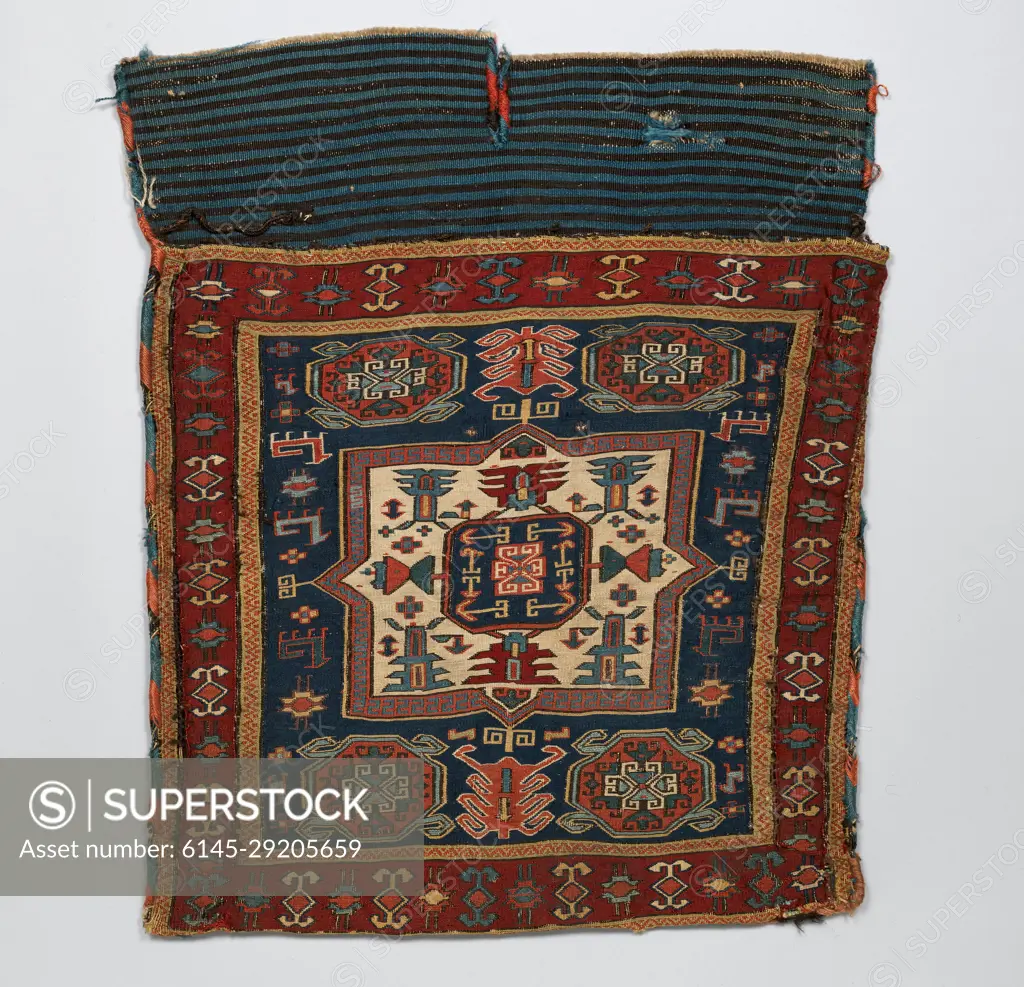
SuperStock offers millions of photos, videos, and stock assets to creatives around the world. This image of Face of Half a Double Saddlebag (Khorjin) ca. 1850 This face, together with # 2015.490.37, once formed a double saddlebag of the Shahsevan tribe, whose name means "those who love the king." The historical migratory range of these Turkic nomads reaches from the southwest shores of the Caspian Sea to the southern part of Transcaucasia. Art historians have identified Shahsevan weavings, including a variety of small-format bags, only in the past half century. Many Shahsevan weavings from the nineteenth and twentieth centuries, especially those with centralized geometric designs - such as seen here - show a striking relationship with Anatolian carpets from the fifteenth and sixteenth centuries. Often compositions are dominated by an octagonal star-like central medallion. Many of the motifs found on Shahsevan textiles are thought to be centuries-old tribal emblems, a symbolic language that today we are frequently unable to decipher.. Face of Half a Double Saddlebag (Khorjin). ca. 1850. Wool by Piemags/PL Photography Limited is available for licensing today.
Looking for a license?
Click here, and we'll help you find it! Questions? Just ask!
Click here, and we'll help you find it! Questions? Just ask!
DETAILS
Image Number: 6145-29205659Royalty FreeCredit Line:Piemags/PL Photography Limited/SuperStockCollection:PL Photography Limited Contributor:Piemags Model Release:NoProperty Release:NoResolution:4000×3858