Ewer. Culture: British, London. Dimensions: Overall (confirmed): 11 3/8 × 10 7/8 × 5 5/8 in., 35.64 oz. (28.9 × 27.6 × 14.3 cm, 1010.5g). Maker: Probably Peter Bettesworth (British). Date: 1635/6.This austere and minimally-decorated silver ewer is remarkable for its clean outline and its energetic, sculptural profile. The dramatic sweep of the elongated spout is balanced by an ear-shaped handle fitted with a thumb piece allowing a grip that balances the weight of the filled vessel. The construction may be simple--it is formed of uncomplicated raised components-- but it is composed with a sure sense of proportion and function. The ewer would have been displayed with a matching basin on a sideboard or cupboard and brought to the table for the washing of hands during a meal. The form of this ewer, with its slightly everted rim, trumpet-shaped foot and flaring spout was employed at least until the 1670s. Only a few examples survive with their basins, which have a broad, plain rim and rai
This asset has restrictions and cannot be purchased online. Get in touch for more details.
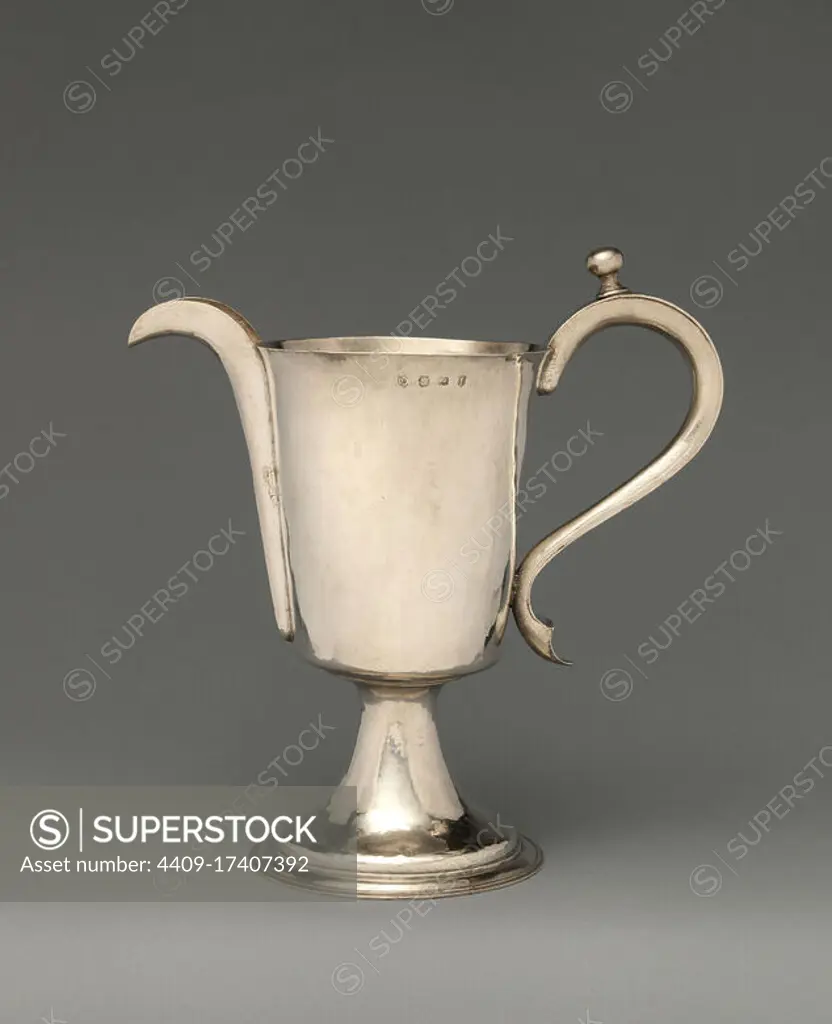
SuperStock offers millions of photos, videos, and stock assets to creatives around the world. This image of Ewer. Culture: British, London. Dimensions: Overall (confirmed): 11 3/8 × 10 7/8 × 5 5/8 in., 35.64 oz. (28.9 × 27.6 × 14.3 cm, 1010.5g). Maker: Probably Peter Bettesworth (British). Date: 1635/6.This austere and minimally-decorated silver ewer is remarkable for its clean outline and its energetic, sculptural profile. The dramatic sweep of the elongated spout is balanced by an ear-shaped handle fitted with a thumb piece allowing a grip that balances the weight of the filled vessel. The construction may be simple--it is formed of uncomplicated raised components-- but it is composed with a sure sense of proportion and function. The ewer would have been displayed with a matching basin on a sideboard or cupboard and brought to the table for the washing of hands during a meal. The form of this ewer, with its slightly everted rim, trumpet-shaped foot and flaring spout was employed at least until the 1670s. Only a few examples survive with their basins, which have a broad, plain rim and rai by Album/Metropolitan Museum of Art, NY/Album Archivo is available for licensing today.
Looking for a license?
Click here, and we'll help you find it! Questions? Just ask!
Click here, and we'll help you find it! Questions? Just ask!
DETAILS
Image Number: 4409-17407392Rights ManagedCredit Line:Album/Metropolitan Museum of Art, NY/Album Archivo/SuperStockCollection:Album Archivo Contributor:Album / Metropolitan Museum of Art, NY Model Release:NoProperty Release:NoResolution:3414×4200