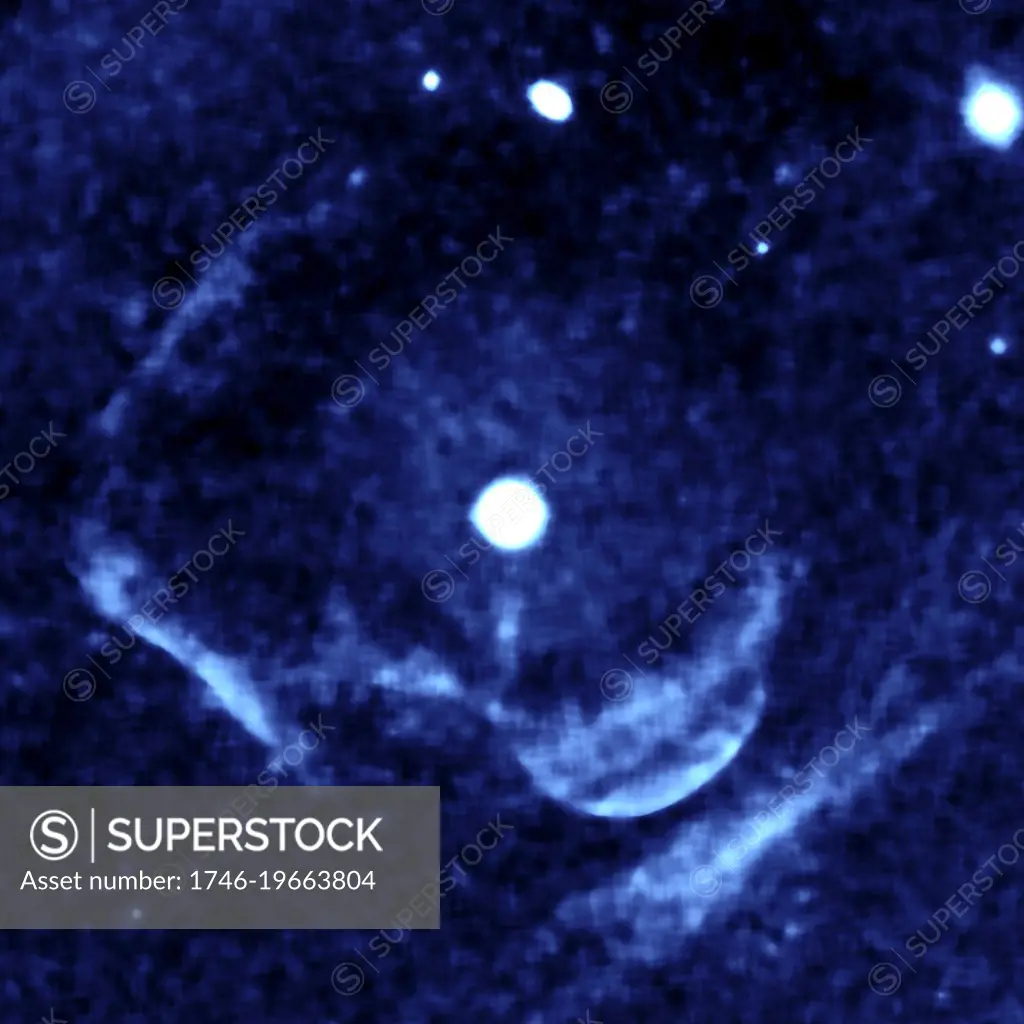
enhanced image from the far-ultraviolet detector on NASAs Galaxy Evolution Explorer shows a ghostly shell of ionized gas around Z Camelopardalis, a binary, or double-star system featuring a collapsed, dead star known as a white dwarf, and a companion star. Z Cam is the bright object near the centre of the image. Parts of the shell are seen as a lobe-like, light-blue feature below and to the right of Z Cam, and as two large, light blue, perpendicular lines on the left. The massive shell around Z Cam provides evidence of material ejected during and swept up by a powerful nova eruption, called a classical nova, which likely occurred a few thousand years ago.
SuperStock offers millions of photos, videos, and stock assets to creatives around the world. This image of enhanced image from the far-ultraviolet detector on NASAs Galaxy Evolution Explorer shows a ghostly shell of ionized gas around Z Camelopardalis, a binary, or double-star system featuring a collapsed, dead star known as a white dwarf, and a companion star. Z Cam is the bright object near the centre of the image. Parts of the shell are seen as a lobe-like, light-blue feature below and to the right of Z Cam, and as two large, light blue, perpendicular lines on the left. The massive shell around Z Cam provides evidence of material ejected during and swept up by a powerful nova eruption, called a classical nova, which likely occurred a few thousand years ago. by World History Archive/Image Asset Management is available for licensing today.
Looking for a license?
Click here, and we'll help you find it! Questions? Just ask!
Click here, and we'll help you find it! Questions? Just ask!
DETAILS
Image Number: 1746-19663804Rights ManagedCredit Line:World History Archive/Image Asset Management/SuperStockCollection:Image Asset Management Contributor:World History Archive Model Release:NoProperty Release:NoResolution:4200×4200