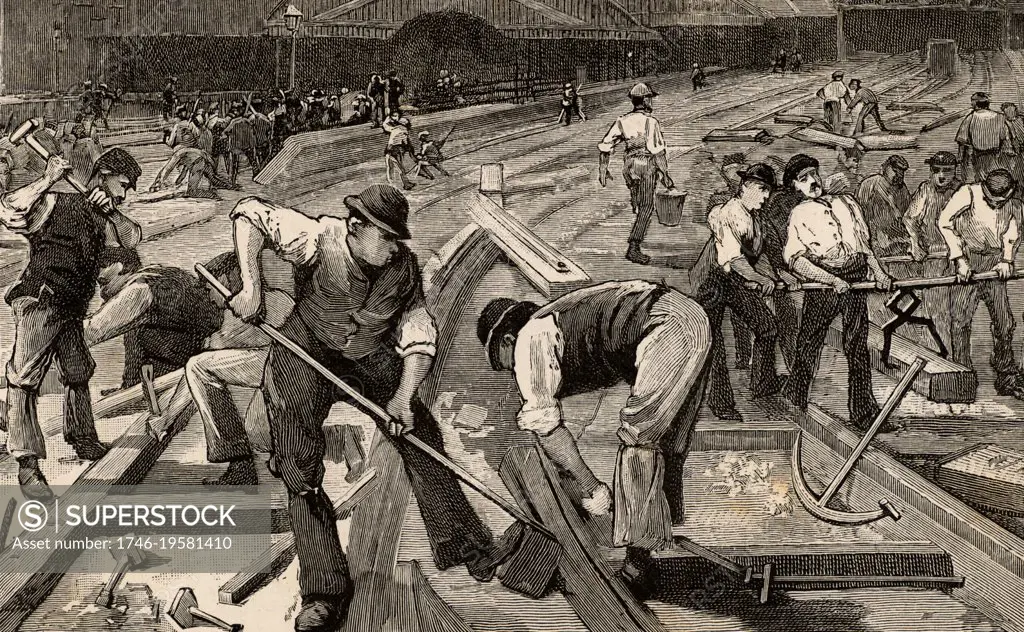
The end of broad gauge, 1892. Work in progress at Plymouth station, Devonshire, to change from broad gauge to standard gauge railway track. Isambard Kingdom Brunel (1806-1859) favoured broad gauge 7ft 1/4inch (2. 2m) and designed the Great Western Railway accordingly. However, in the Gauge Act of 1846 Parliament declared that all future railway track should be of the standard 4ft 8 1/2inch (1. 44m) gauge introduced by George Stephenson (1781-1848) on the Liverpool & Manchester Railway. It was not until 1892 that the last broad gauge track was lifted. From 'The Romance of Engineering' by Henry Frith. (London, 1892).
SuperStock offers millions of photos, videos, and stock assets to creatives around the world. This image of The end of broad gauge, 1892. Work in progress at Plymouth station, Devonshire, to change from broad gauge to standard gauge railway track. Isambard Kingdom Brunel (1806-1859) favoured broad gauge 7ft 1/4inch (2. 2m) and designed the Great Western Railway accordingly. However, in the Gauge Act of 1846 Parliament declared that all future railway track should be of the standard 4ft 8 1/2inch (1. 44m) gauge introduced by George Stephenson (1781-1848) on the Liverpool & Manchester Railway. It was not until 1892 that the last broad gauge track was lifted. From 'The Romance of Engineering' by Henry Frith. (London, 1892). by World History Archive/Image Asset Management is available for licensing today.
Looking for a license?
Click here, and we'll help you find it! Questions? Just ask!
Click here, and we'll help you find it! Questions? Just ask!
DETAILS
Image Number: 1746-19581410Rights ManagedCredit Line:World History Archive/Image Asset Management/SuperStockCollection:Image Asset Management Contributor:World History Archive Model Release:NoProperty Release:NoResolution:3500×2161