Division Viol ca. 1720 School of Tielke Slightly smaller than the bass viola da gamba, the division viol is an instrument ideal for playing improvised variations (or "divisions") upon a repeated bassline, or ground. Division viols grew in popularity in England in the seventeenth century alongside publications of methodical treatises, such as Christopher Simpson's The Division Viol of 1665 and The Division-Violist of 1669, as well as John Playford's A Brief Introduction of 1667. Because of its large compass and range of over three octaves, the instrument allowed accomplished performers to play polyphonic compositions and rapid passagework, but was also ideal for informal consort playing.In its original condition, this viol's six strings would have been tuned to D-G-c-e-a-d', but its alterationsits modern German 'cello neck and pegbox, a reduction to four strings, and its coat of transparent red-orange varnishindicate that at one time it was used as a 'cello, as many such instruments w
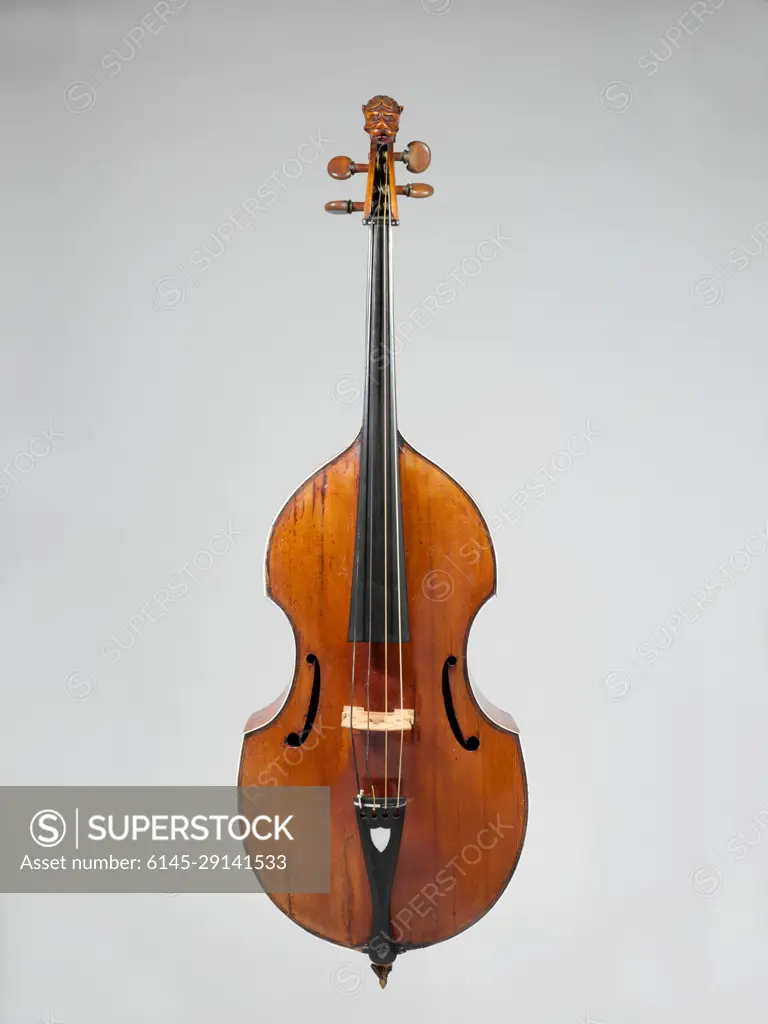
Division Viol ca. 1720 School of Tielke Slightly smaller than the bass viola da gamba, the division viol is an instrument ideal for playing improvised variations (or "divisions") upon a repeated bassline, or ground. Division viols grew in popularity in England in the seventeenth century alongside publications of methodical treatises, such as Christopher Simpson's The Division Viol of 1665 and The Division-Violist of 1669, as well as John Playford's A Brief Introduction of 1667. Because of its large compass and range of over three octaves, the instrument allowed accomplished performers to play polyphonic compositions and rapid passagework, but was also ideal for informal consort playing.In its original condition, this viol's six strings would have been tuned to D-G-c-e-a-d', but its alterationsits modern German 'cello neck and pegbox, a reduction to four strings, and its coat of transparent red-orange varnishindicate that at one time it was used as a 'cello, as many such instruments w
SuperStock offers millions of photos, videos, and stock assets to creatives around the world. This image of Explore the Rich Sound of the Double Bass: A Guide to Understanding Its Role in Classical and Jazz Music by Piemags/PL Photography Limited is available for licensing today.
Royalty Free License
Royalty-Free Standard Commercial licenses are granted for worldwide, non-exclusive and perpetual use, unless specifically noted otherwise. All Royalty-Free transactions are final. The Royalty-Free Standard Commercial license has no limitations and covers up to 15 users.
  • $50.00 Low375 X 500
  • $150.00 Med562 X 750
  • $250.00 High3000 X 4000
  • Download your images from the download tab on this page after purchase.
  • Up to 5 downloads
  • Can be used for a year after purchase.
$1,225.00
RF High / Super Res 5 Pack
Save $25.00
$245.00
per download
Order a Framed Print
Looking for a license?
Click here, and we'll help you find it! Questions? Just ask!
DETAILS
Image Number: 6145-29141533Royalty FreeCredit Line:Piemags/PL Photography Limited/SuperStockCollection:PL Photography LimitedContributor:PiemagsModel Release:NoProperty Release:NoResolution:3000×4000
|
|
|
|
|
|
|
|
|
|
|
|
|
|
|
|
|
|
|
|
|
|
|
|
|
|
|
|
|
|
|
|
|
|
|
|
|
|
|
|
|
|
|
|
|
|
|
|
|
|
|
|
|
|
|
|
|
|
|
|
|
|
|