The Dirty Bride or The Wedding of Mopsus and Nisa. Artist: Pieter Bruegel the Elder (Netherlandish, Breda () ca. 1525-1569 Brussels). Dimensions: Overall: 10 3/8 x 16 3/8 x 1 1/8 in. (26.4 x 41.6 x 2.9 cm). Date: ca. 1566.This remarkable drawing represents a group of street performers putting on a comic folk play, The Dirty Bride (De Vuile Bruid) on the occasion of Shrovetide, the three days before Ash Wednesday. The coarse, bedraggled bride being led from a shabby nuptial tent is Nisa, while the prancing groom who leads her out is Mopsus. The account of their marriage derives from the Eighth Eclogue of the Roman poet Virgil, but also appeared in several contemporary books of proverbs, in which it was used to indicate a world turned upside down. In this print after Bruegel's drawing, which was engraved by Pieter van der Heyden and published by Hieronymus Cock in 1570, a Latin inscription was added below the image that translates "Mopsus marries Nisa, what may not we lovers hope for"-
This asset has restrictions and cannot be purchased online. Get in touch for more details.
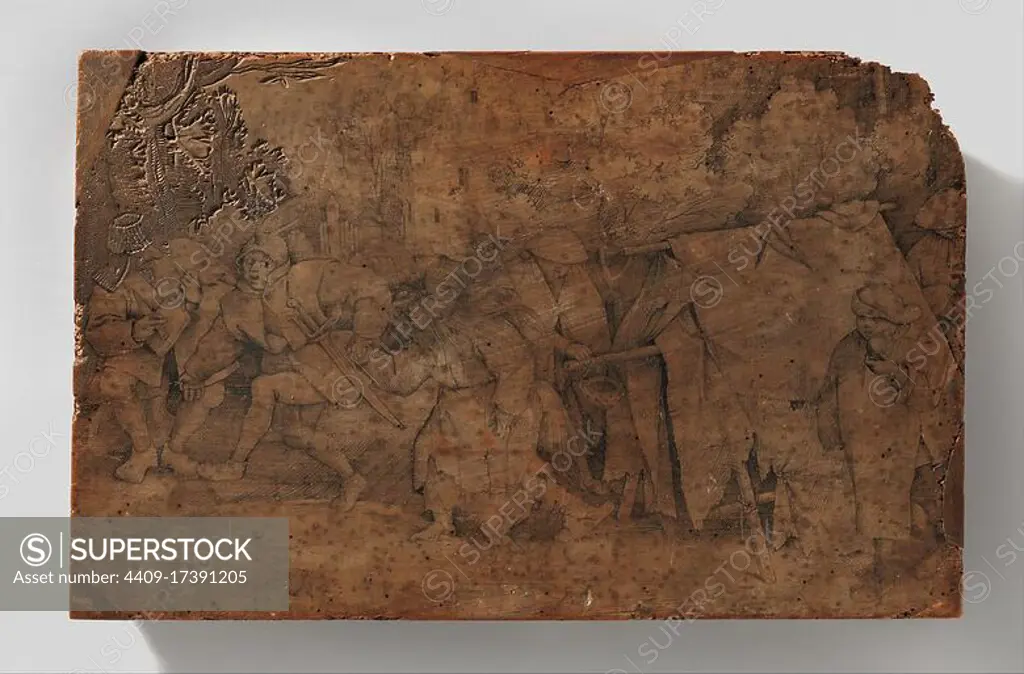
SuperStock offers millions of photos, videos, and stock assets to creatives around the world. This image of The Dirty Bride or The Wedding of Mopsus and Nisa. Artist: Pieter Bruegel the Elder (Netherlandish, Breda () ca. 1525-1569 Brussels). Dimensions: Overall: 10 3/8 x 16 3/8 x 1 1/8 in. (26.4 x 41.6 x 2.9 cm). Date: ca. 1566.This remarkable drawing represents a group of street performers putting on a comic folk play, The Dirty Bride (De Vuile Bruid) on the occasion of Shrovetide, the three days before Ash Wednesday. The coarse, bedraggled bride being led from a shabby nuptial tent is Nisa, while the prancing groom who leads her out is Mopsus. The account of their marriage derives from the Eighth Eclogue of the Roman poet Virgil, but also appeared in several contemporary books of proverbs, in which it was used to indicate a world turned upside down. In this print after Bruegel's drawing, which was engraved by Pieter van der Heyden and published by Hieronymus Cock in 1570, a Latin inscription was added below the image that translates "Mopsus marries Nisa, what may not we lovers hope for"- by Album/Metropolitan Museum of Art, NY/Album Archivo is available for licensing today.
Looking for a license?
Click here, and we'll help you find it! Questions? Just ask!
Click here, and we'll help you find it! Questions? Just ask!
DETAILS
Image Number: 4409-17391205Rights ManagedCredit Line:Album/Metropolitan Museum of Art, NY/Album Archivo/SuperStockCollection:Album Archivo Contributor:Album / Metropolitan Museum of Art, NY Model Release:NoProperty Release:NoResolution:4318×2847