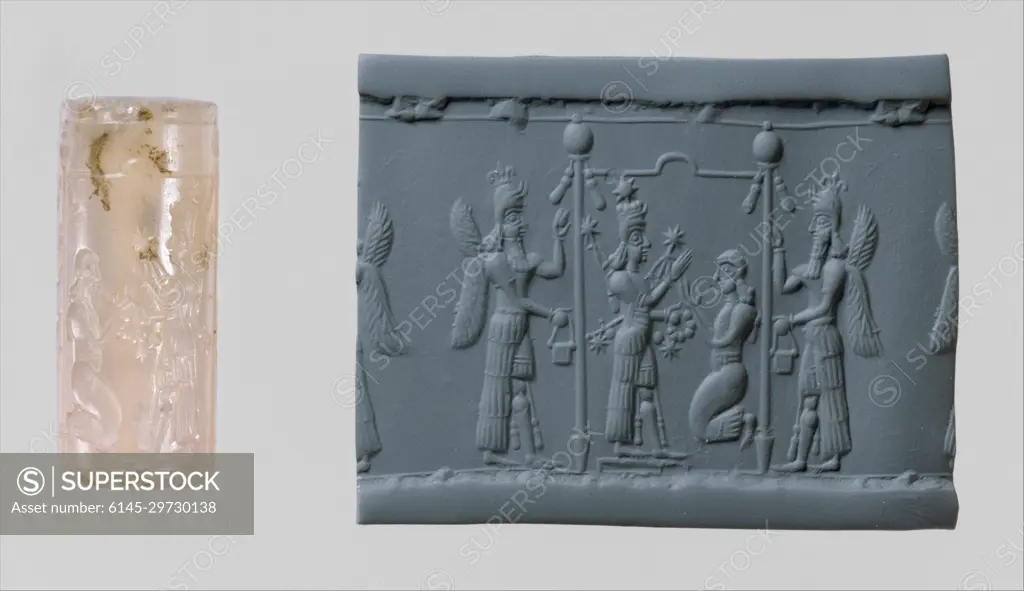
Cylinder seal with cultic scene late 9th - early 8th century B.C. Assyrian Seals of the early first millennium B.C. in Babylonia and Assyria were carved in the linear, drilled, cut, and modeled styles. The modeled style illustrated here derives from earlier Middle Assyrian seal carving and from the modeled sculpture in the palace of Sargon II (r. 721-705 B.C.), king of Assyria at Khorsabad. This style was used predominantly on seals showing scenes of contest and worship.On this cylinder seal a statue of the goddess Ishtar stands on a platform within a canopied enclosure. Ishtar is identified by crossed quivers, a starred crown, and stars encircling her body. Two winged genies protect the enclosure, while a kneeling figure worships.. Cylinder seal with cultic scene. Assyrian. late 9th - early 8th century B.C.. Flawed neutral Chalcedony (Quartz). Neo-Assyrian. Mesopotamia
SuperStock offers millions of photos, videos, and stock assets to creatives around the world. This image of Cylinder seal with cultic scene late 9th - early 8th century B.C. Assyrian Seals of the early first millennium B.C. in Babylonia and Assyria were carved in the linear, drilled, cut, and modeled styles. The modeled style illustrated here derives from earlier Middle Assyrian seal carving and from the modeled sculpture in the palace of Sargon II (r. 721-705 B.C.), king of Assyria at Khorsabad. This style was used predominantly on seals showing scenes of contest and worship.On this cylinder seal a statue of the goddess Ishtar stands on a platform within a canopied enclosure. Ishtar is identified by crossed quivers, a starred crown, and stars encircling her body. Two winged genies protect the enclosure, while a kneeling figure worships.. Cylinder seal with cultic scene. Assyrian. late 9th - early 8th century B.C.. Flawed neutral Chalcedony (Quartz). Neo-Assyrian. Mesopotamia by Piemags/PL Photography Limited is available for licensing today.
Looking for a license?
Click here, and we'll help you find it! Questions? Just ask!
Click here, and we'll help you find it! Questions? Just ask!
DETAILS
Image Number: 6145-29730138Royalty FreeCredit Line:Piemags/PL Photography Limited/SuperStockCollection:PL Photography Limited Contributor:Piemags Model Release:NoProperty Release:NoResolution:3811×2202