Curb Bit early 17th century German This bit was used for the training of young horses and starting them with the curb bit. Despite their impressive aspect, the straight elongated shanks were in fact thought to be more gentle on the horse, because of the longer reaction time in their leverage effect and the fact that they were stopped by the horse's chest at some point. Curb bits were also used with a very light hand, the well-trained horses responding by anticipation to the slightest move of the reins. This mouthpiece, made of simple articulated canons, was the simplest that could be found at the time. The banquets, the parts of the cheekpieces to which the mouthpiece is attached, can be opened for switch out the mouthpiece, a feature particularly appreciated on dressage bits in Germany.At the beginning of the training, this bit would have been combined with a cavesson, a rigid noseband, often made of iron, resting on the horses nose, a sensitive area. The rider would use his cavesson
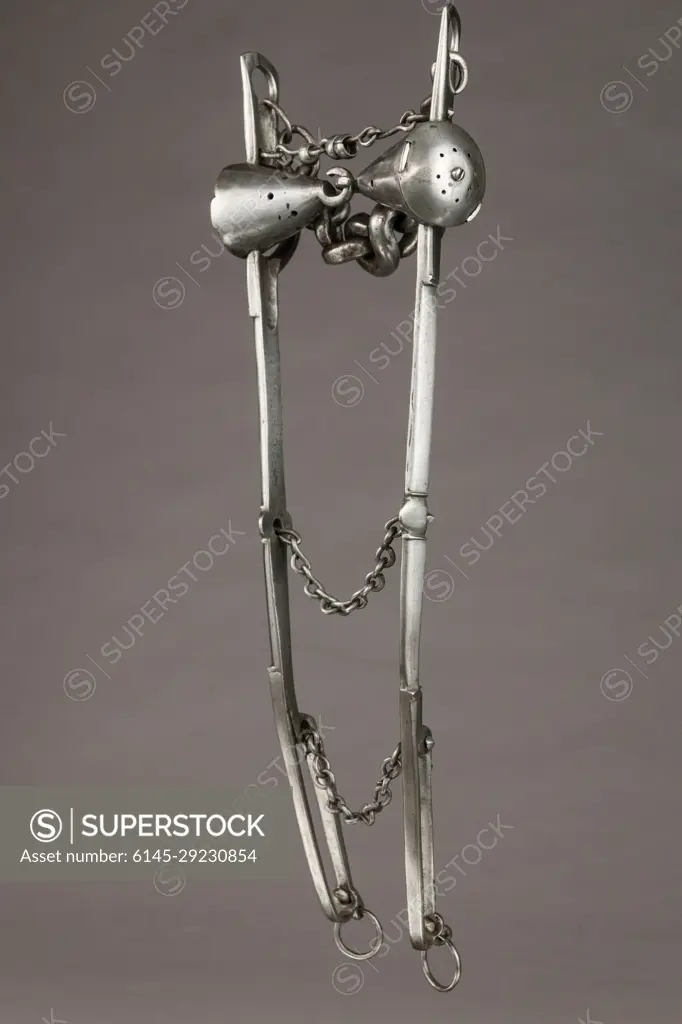
SuperStock offers millions of photos, videos, and stock assets to creatives around the world. This image of Curb Bit early 17th century German This bit was used for the training of young horses and starting them with the curb bit. Despite their impressive aspect, the straight elongated shanks were in fact thought to be more gentle on the horse, because of the longer reaction time in their leverage effect and the fact that they were stopped by the horse's chest at some point. Curb bits were also used with a very light hand, the well-trained horses responding by anticipation to the slightest move of the reins. This mouthpiece, made of simple articulated canons, was the simplest that could be found at the time. The banquets, the parts of the cheekpieces to which the mouthpiece is attached, can be opened for switch out the mouthpiece, a feature particularly appreciated on dressage bits in Germany.At the beginning of the training, this bit would have been combined with a cavesson, a rigid noseband, often made of iron, resting on the horses nose, a sensitive area. The rider would use his cavesson by Piemags/PL Photography Limited is available for licensing today.
Looking for a license?
Click here, and we'll help you find it! Questions? Just ask!
Click here, and we'll help you find it! Questions? Just ask!
DETAILS
Image Number: 6145-29230854Royalty FreeCredit Line:Piemags/PL Photography Limited/SuperStockCollection:PL Photography Limited Contributor:Piemags Model Release:NoProperty Release:NoResolution:2667×4000