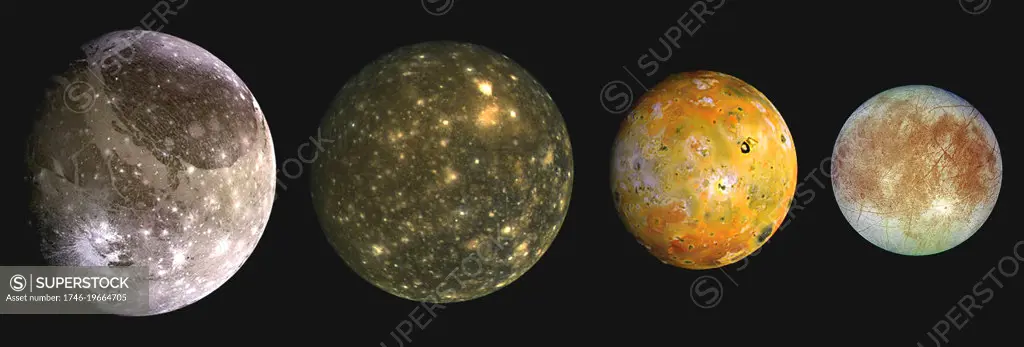
This composite includes the four largest moons of Jupiter which are known as the Galilean satellites. From left to right, the moons shown are Ganymede, Callisto, Io, and Europa. The Galilean satellites were first seen by the Italian astronomer Galileo Galilei in 1610. In order of increasing distance from Jupiter, Io is closest, followed by Europa, Ganymede, and Callisto. The order of these satellites from the planet Jupiter helps to explain some of the visible differences among the moons. Io is subject to the strongest tidal stresses from the massive planet. These stresses generate internal heating which is released at the surface and makes Io the most volcanically active body in our solar system. Europa appears to be strongly differentiated with a rock/iron core, an ice layer at its surface, and the potential for local or global zones of water between these layers. Tectonic resurfacing brightens terrain on the less active and partially differentiated moon Ganymede. Callisto, furthest
SuperStock offers millions of photos, videos, and stock assets to creatives around the world. This image of This composite includes the four largest moons of Jupiter which are known as the Galilean satellites. From left to right, the moons shown are Ganymede, Callisto, Io, and Europa. The Galilean satellites were first seen by the Italian astronomer Galileo Galilei in 1610. In order of increasing distance from Jupiter, Io is closest, followed by Europa, Ganymede, and Callisto. The order of these satellites from the planet Jupiter helps to explain some of the visible differences among the moons. Io is subject to the strongest tidal stresses from the massive planet. These stresses generate internal heating which is released at the surface and makes Io the most volcanically active body in our solar system. Europa appears to be strongly differentiated with a rock/iron core, an ice layer at its surface, and the potential for local or global zones of water between these layers. Tectonic resurfacing brightens terrain on the less active and partially differentiated moon Ganymede. Callisto, furthest by World History Archive/Image Asset Management is available for licensing today.
Looking for a license?
Click here, and we'll help you find it! Questions? Just ask!
Click here, and we'll help you find it! Questions? Just ask!
DETAILS
Image Number: 1746-19664705Rights ManagedCredit Line:World History Archive/Image Asset Management/SuperStockCollection:Image Asset Management Contributor:World History Archive Model Release:NoProperty Release:NoResolution:7792×2646