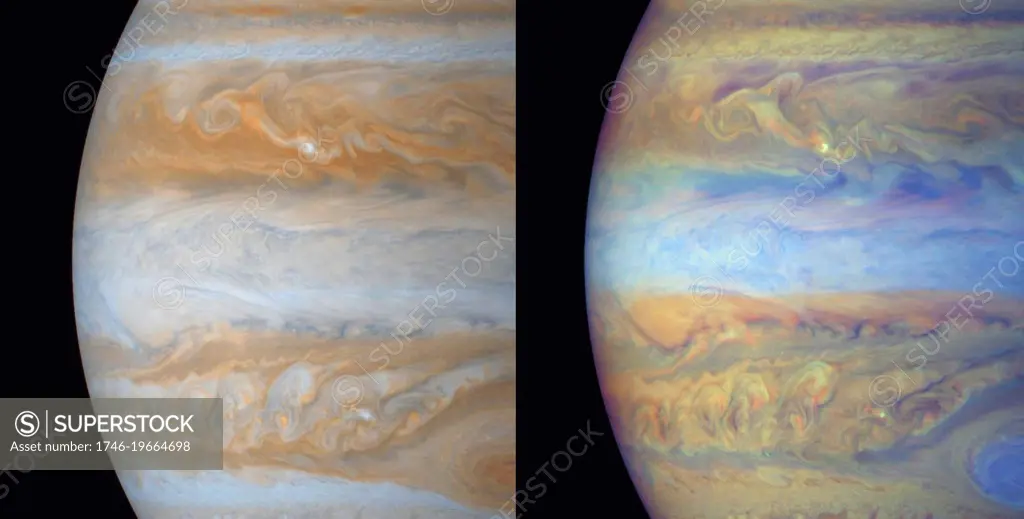
composite frames of the mid-section of Jupiter were of narrow angle images acquired on December 31, 2000, a day after Cassinis closest approach to the planet. The smallest features in these frames are roughly ~ 60 kilometres. The left is natural colour, composited to yield the colour that Jupiter would have if seen by the naked eye. The right frame is composed of 3 images: two were taken through narrow band filters cantered on regions of the spectrum where the gaseous methane in Jupiters atmosphere absorbs light, and the third was taken in a red continuum region of the spectrum, where Jupiter has no absorptions.
SuperStock offers millions of photos, videos, and stock assets to creatives around the world. This image of composite frames of the mid-section of Jupiter were of narrow angle images acquired on December 31, 2000, a day after Cassinis closest approach to the planet. The smallest features in these frames are roughly ~ 60 kilometres. The left is natural colour, composited to yield the colour that Jupiter would have if seen by the naked eye. The right frame is composed of 3 images: two were taken through narrow band filters cantered on regions of the spectrum where the gaseous methane in Jupiters atmosphere absorbs light, and the third was taken in a red continuum region of the spectrum, where Jupiter has no absorptions. by World History Archive/Image Asset Management is available for licensing today.
Looking for a license?
Click here, and we'll help you find it! Questions? Just ask!
Click here, and we'll help you find it! Questions? Just ask!
DETAILS
Image Number: 1746-19664698Rights ManagedCredit Line:World History Archive/Image Asset Management/SuperStockCollection:Image Asset Management Contributor:World History Archive Model Release:NoProperty Release:NoResolution:5990×3041