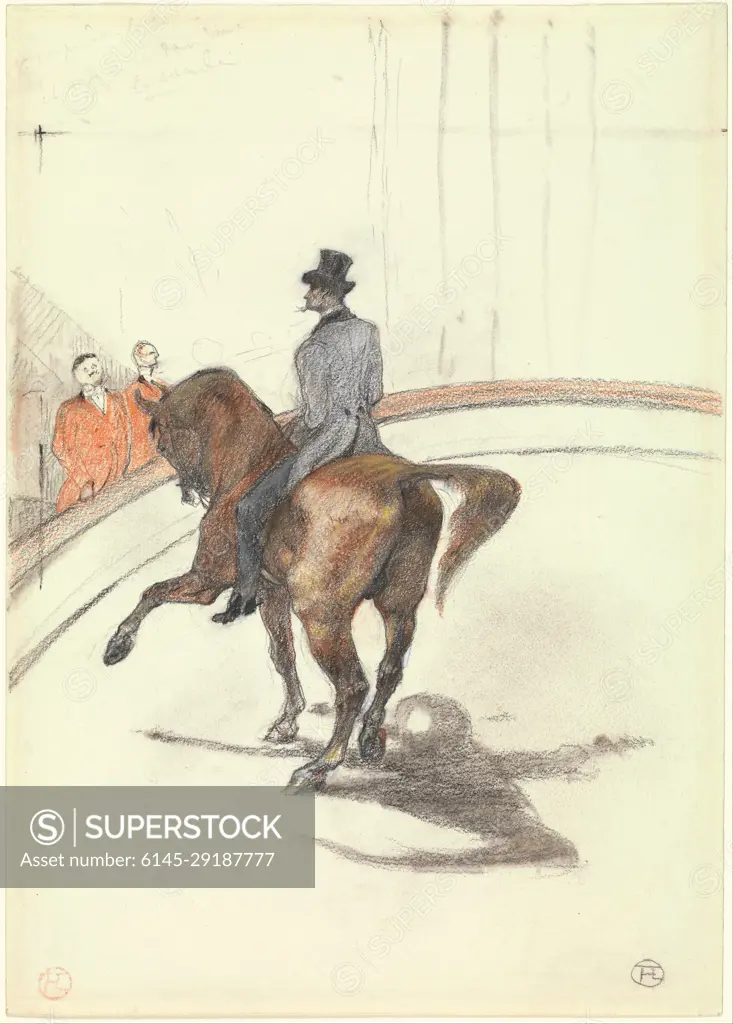
At the Circus: The Spanish Walk (Au Cirque: Le Pas espagnol) 1899 Henri de Toulouse-Lautrec French The grand master of urban entertainments, Henri de Toulouse-Lautrec made many paintings and drawings on the circus theme in the late 1880s and 1890s, just as his popularity as a commercial artist soared. Fin-de-siècle Paris hosted an assortment of professional circuses, and Lautrec frequented them all. He was personally drawn to circus performers-those colorful equestrians, animal trainers, clowns and acrobats on society's "fringes." It was while undergoing treatment for alcoholism at a sanitarium on the outskirts of Paris in 1899 that Lautrec produced an ambitious group of crayon/chalk drawings of circus figures. These imaginative sketches were drawn entirely from memory, without recourse to preliminary studies. The Lehman horse and rider perform the "pas espagnol", the ambling gait formalized by the Spanish Riding School of Vienna. It was thanks to these circus drawings that Lautrec ear
SuperStock offers millions of photos, videos, and stock assets to creatives around the world. This image of At the Circus: The Spanish Walk (Au Cirque: Le Pas espagnol) 1899 Henri de Toulouse-Lautrec French The grand master of urban entertainments, Henri de Toulouse-Lautrec made many paintings and drawings on the circus theme in the late 1880s and 1890s, just as his popularity as a commercial artist soared. Fin-de-siècle Paris hosted an assortment of professional circuses, and Lautrec frequented them all. He was personally drawn to circus performers-those colorful equestrians, animal trainers, clowns and acrobats on society's "fringes." It was while undergoing treatment for alcoholism at a sanitarium on the outskirts of Paris in 1899 that Lautrec produced an ambitious group of crayon/chalk drawings of circus figures. These imaginative sketches were drawn entirely from memory, without recourse to preliminary studies. The Lehman horse and rider perform the "pas espagnol", the ambling gait formalized by the Spanish Riding School of Vienna. It was thanks to these circus drawings that Lautrec ear by Piemags/PL Photography Limited is available for licensing today.
Looking for a license?
Click here, and we'll help you find it! Questions? Just ask!
Click here, and we'll help you find it! Questions? Just ask!
DETAILS
Image Number: 6145-29187777Royalty FreeCredit Line:Piemags/PL Photography Limited/SuperStockCollection:PL Photography Limited Contributor:Piemags Model Release:NoProperty Release:NoResolution:2769×3867