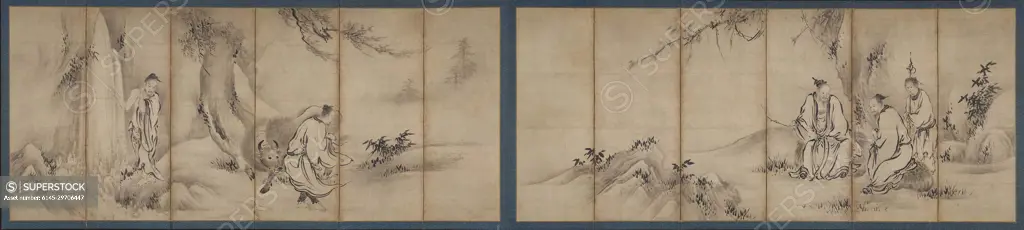
Chinese Sages late 16th-early 17th century Attributed to Kano Sanraku This pair of screens portrays well-known but seldom pictorialized stories. At right is Huang Chuping, a shepherd who gained the ability to transform stones into sheep. Flanked by his skeptical brother and a young attendant, Chuping fixes his gaze on a bright white rock in the bottom of the third panel, where a smudge of ink suggests an impending transformation. At left is a pair of recluses. Xu You, disquieted after declining an offer to take over the empire, rushes to wash his ears in a spring. Chaofu decides that the spring is now too polluted to water his bull.The screens are a masterwork of the so-called gy, or “running,” style of ink painting. With origins in Southern Song Chinese painting, it is one of three styles assimilated by medieval Japanese artists and transformed by early Kano school painters, especially Kano Motonobu and his grandson Eitoku (1543-1590).. Chinese Sages. Attributed to Kano Sanraku (Japa
SuperStock offers millions of photos, videos, and stock assets to creatives around the world. This image of Chinese Sages late 16th-early 17th century Attributed to Kano Sanraku This pair of screens portrays well-known but seldom pictorialized stories. At right is Huang Chuping, a shepherd who gained the ability to transform stones into sheep. Flanked by his skeptical brother and a young attendant, Chuping fixes his gaze on a bright white rock in the bottom of the third panel, where a smudge of ink suggests an impending transformation. At left is a pair of recluses. Xu You, disquieted after declining an offer to take over the empire, rushes to wash his ears in a spring. Chaofu decides that the spring is now too polluted to water his bull.The screens are a masterwork of the so-called gy, or “running,” style of ink painting. With origins in Southern Song Chinese painting, it is one of three styles assimilated by medieval Japanese artists and transformed by early Kano school painters, especially Kano Motonobu and his grandson Eitoku (1543-1590).. Chinese Sages. Attributed to Kano Sanraku (Japa by Piemags/PL Photography Limited is available for licensing today.
Looking for a license?
Click here, and we'll help you find it! Questions? Just ask!
Click here, and we'll help you find it! Questions? Just ask!
DETAILS
Image Number: 6145-29706447Royalty FreeCredit Line:Piemags/PL Photography Limited/SuperStockCollection:PL Photography Limited Contributor:Piemags Model Release:NoProperty Release:NoResolution:3360×755