Chinese Palampore 1750-1800 China (Guangzhou), for the European or American market This Chinese embroidered palampore represents the closing of the trade circle of the central tree design, which originated in China, was adapted in England in the mid-seventeenth century, then introduced by English East India Company merchants to textile painters in India. This silk version was made in the late eighteenth century in China, where Cantonese craftspeople embroidered it in imitation of an Indian painted cotton palampore. When it was donated to the Museum in 1947, it was placed in the American Wing, indicating the donor believed it had a history of American ownership. It could have traveled to the newly formed United States on an American ship after 1784, when direct trade with China was established.cat. no. 120. Chinese Palampore 69860
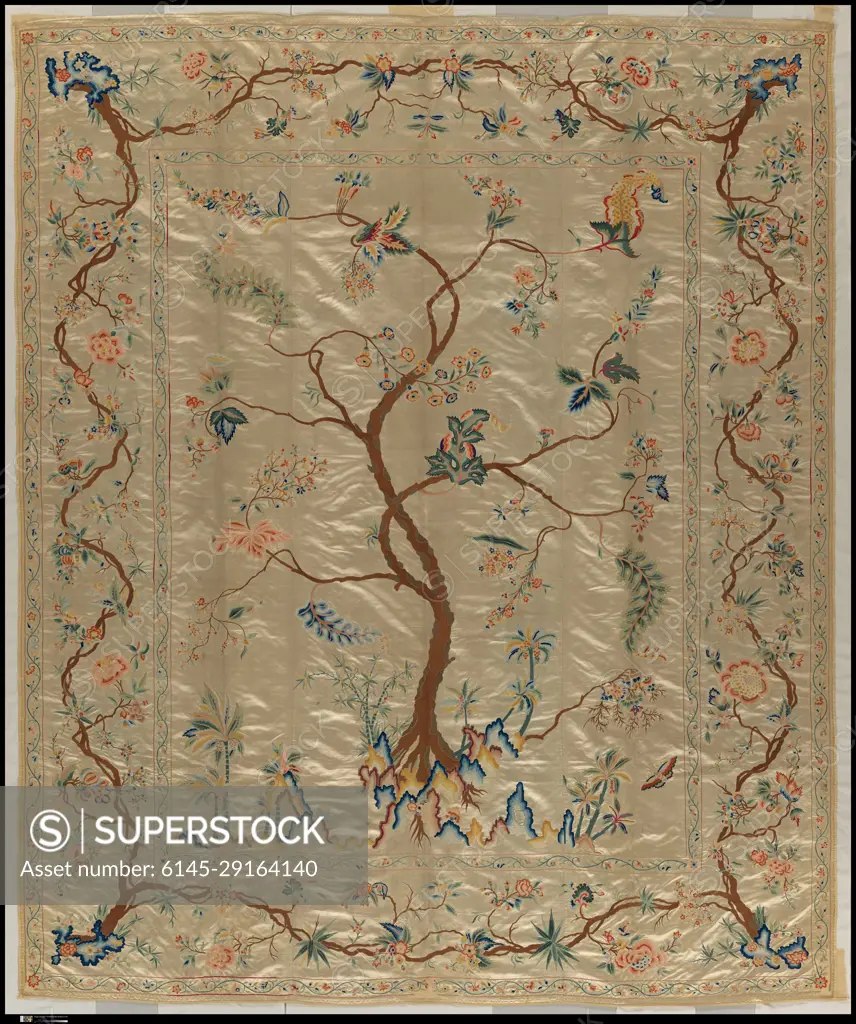
SuperStock offers millions of photos, videos, and stock assets to creatives around the world. This image of Chinese Palampore 1750-1800 China (Guangzhou), for the European or American market This Chinese embroidered palampore represents the closing of the trade circle of the central tree design, which originated in China, was adapted in England in the mid-seventeenth century, then introduced by English East India Company merchants to textile painters in India. This silk version was made in the late eighteenth century in China, where Cantonese craftspeople embroidered it in imitation of an Indian painted cotton palampore. When it was donated to the Museum in 1947, it was placed in the American Wing, indicating the donor believed it had a history of American ownership. It could have traveled to the newly formed United States on an American ship after 1784, when direct trade with China was established.cat. no. 120. Chinese Palampore 69860 by Piemags/PL Photography Limited is available for licensing today.
Looking for a license?
Click here, and we'll help you find it! Questions? Just ask!
Click here, and we'll help you find it! Questions? Just ask!
DETAILS
Image Number: 6145-29164140Royalty FreeCredit Line:Piemags/PL Photography Limited/SuperStockCollection:PL Photography Limited Contributor:Piemags Model Release:NoProperty Release:NoResolution:3346×4000