Chasuble second quarter 18th century Indian, Coromandel Coast and Central European, for European market This chasuble is constructed from a most unusual textile, from which two distinct designs were taken to create the front and back of the vestment. The back of the garment, shown here, was made from a portion of the fabric with a pattern of repeating mound-shaped motifs enclosed in an ogival frame linked by floral sprays; the front uses a pattern of red diamond-shaped motifs resting on a blue band, which once appeared on each side of the repeating-mound pattern. A departure from most of the dyed cloths made for export on Indias Coromandel Coast, this textile finds its closest visual parallel in a group of European brocaded silks now referred to as "lace-patterned." These eighteenth-century textiles are characterized by the use of large-scale motifs, especially streamers and floral sprays, which are set against delicate, lacelike diaper patterning and floral vines. Although these silk
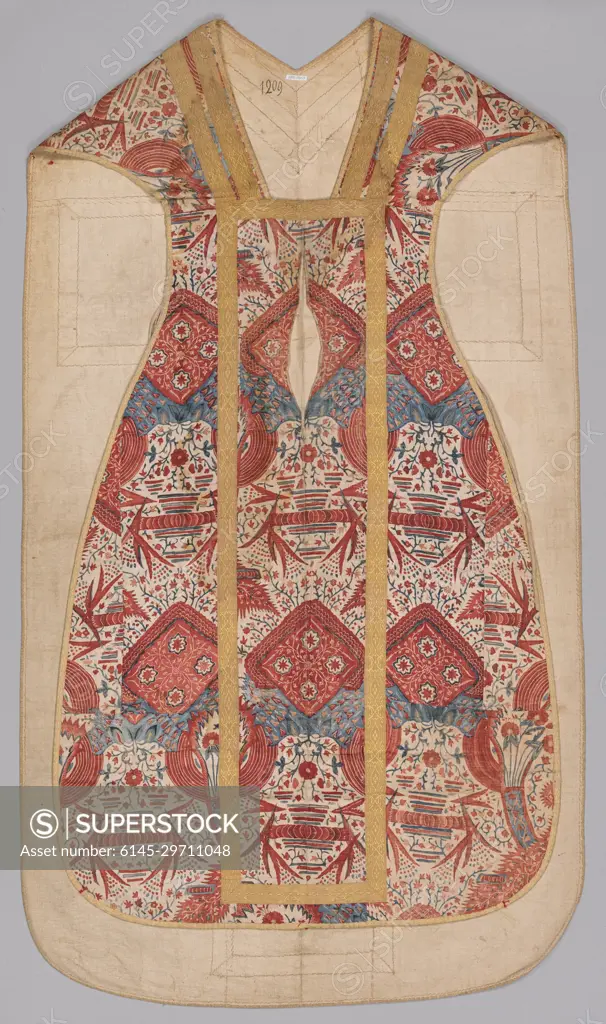
SuperStock offers millions of photos, videos, and stock assets to creatives around the world. This image of Chasuble second quarter 18th century Indian, Coromandel Coast and Central European, for European market This chasuble is constructed from a most unusual textile, from which two distinct designs were taken to create the front and back of the vestment. The back of the garment, shown here, was made from a portion of the fabric with a pattern of repeating mound-shaped motifs enclosed in an ogival frame linked by floral sprays; the front uses a pattern of red diamond-shaped motifs resting on a blue band, which once appeared on each side of the repeating-mound pattern. A departure from most of the dyed cloths made for export on Indias Coromandel Coast, this textile finds its closest visual parallel in a group of European brocaded silks now referred to as "lace-patterned." These eighteenth-century textiles are characterized by the use of large-scale motifs, especially streamers and floral sprays, which are set against delicate, lacelike diaper patterning and floral vines. Although these silk by Piemags/PL Photography Limited is available for licensing today.
Looking for a license?
Click here, and we'll help you find it! Questions? Just ask!
Click here, and we'll help you find it! Questions? Just ask!
DETAILS
Image Number: 6145-29711048Royalty FreeCredit Line:Piemags/PL Photography Limited/SuperStockCollection:PL Photography Limited Contributor:Piemags Model Release:NoProperty Release:NoResolution:1156×1951