Chan master riding a mule before 1249 Unidentified artist Painted in a few swift brushstrokes and deftly applied ink washes, Chan Master Riding a Mule exemplifies the freely expressive manner of Chan (Zen, in Japanese) Buddhist painting, which relies less on descriptive detail than on the capturing of spiritual concentration within the artist to achieve a vivid depiction. Inscribed by the noted Chan master Wuzhun, to whom it traditionally has been attributed, the painting is probably the work of a contemporary Chan artist following the sketchy brush style of Liang Kai (active first half of the thirteenthcentury).Wuzhun, well known for his wisdom as well as for his eccentric behavior, inscribed this painting while he was living at the Qingshansi, a Chan temple near Hangzhou, where he settled after he was rewarded by Emperor Lizong (r. 1225-1264) following an imperial audience. The rider's facial features-prominent forehead, mustache, and wispy beard-are not unlike those of Wuzhun himsel
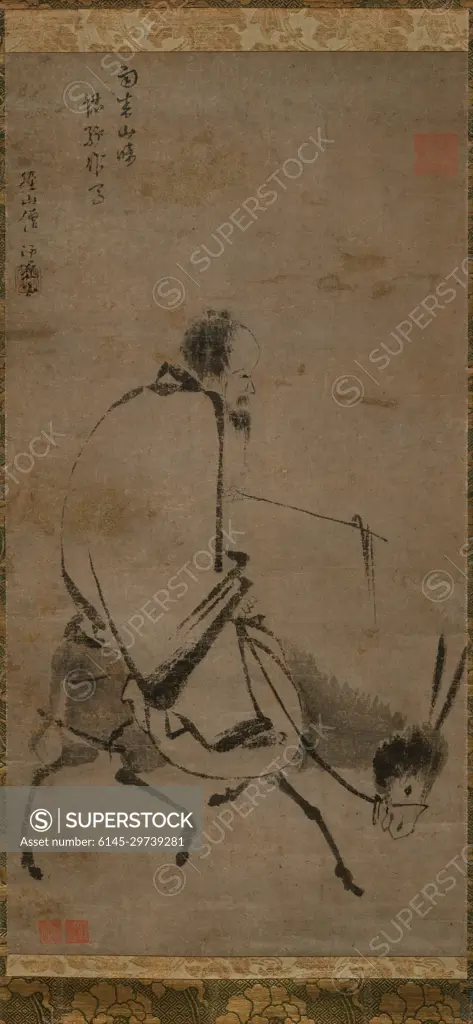
SuperStock offers millions of photos, videos, and stock assets to creatives around the world. This image of Chan master riding a mule before 1249 Unidentified artist Painted in a few swift brushstrokes and deftly applied ink washes, Chan Master Riding a Mule exemplifies the freely expressive manner of Chan (Zen, in Japanese) Buddhist painting, which relies less on descriptive detail than on the capturing of spiritual concentration within the artist to achieve a vivid depiction. Inscribed by the noted Chan master Wuzhun, to whom it traditionally has been attributed, the painting is probably the work of a contemporary Chan artist following the sketchy brush style of Liang Kai (active first half of the thirteenthcentury).Wuzhun, well known for his wisdom as well as for his eccentric behavior, inscribed this painting while he was living at the Qingshansi, a Chan temple near Hangzhou, where he settled after he was rewarded by Emperor Lizong (r. 1225-1264) following an imperial audience. The rider's facial features-prominent forehead, mustache, and wispy beard-are not unlike those of Wuzhun himsel by Piemags/PL Photography Limited is available for licensing today.
Looking for a license?
Click here, and we'll help you find it! Questions? Just ask!
Click here, and we'll help you find it! Questions? Just ask!
DETAILS
Image Number: 6145-29739281Royalty FreeCredit Line:Piemags/PL Photography Limited/SuperStockCollection:PL Photography Limited Contributor:Piemags Model Release:NoProperty Release:NoResolution:1755×3797