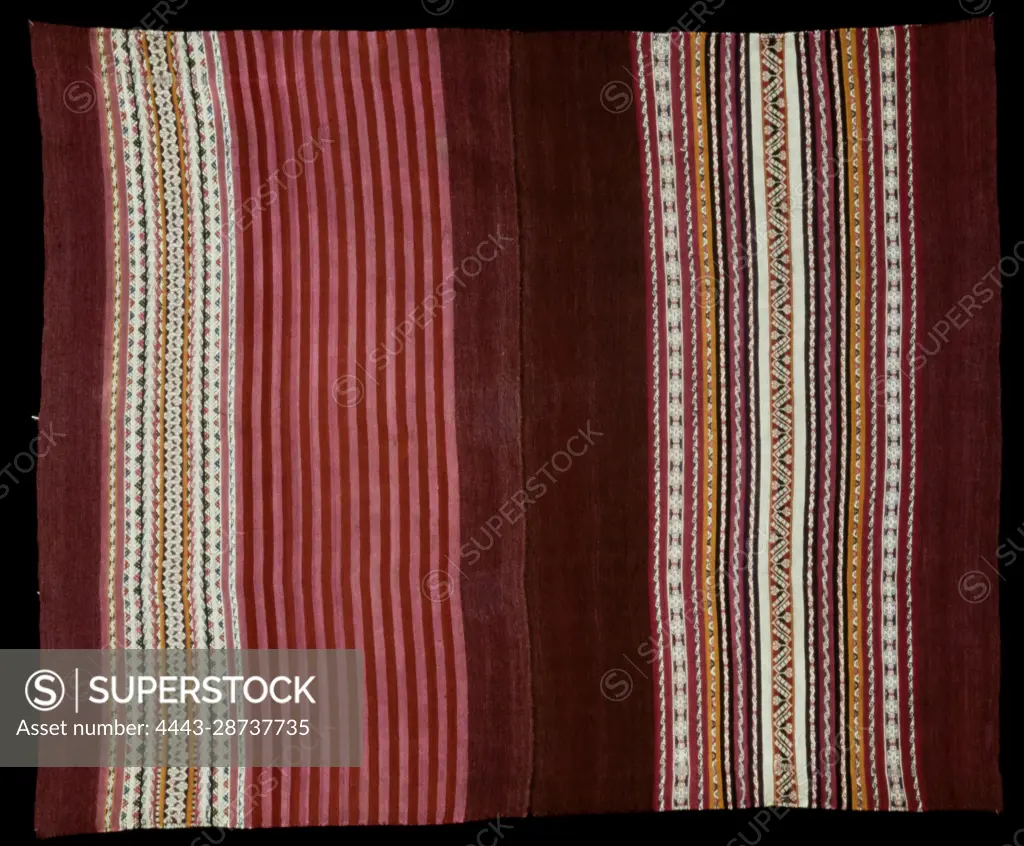
Ceremonial overskirt (aksu), 19th century, 56 1/4 x 47 1/4 in. (142.9 x 120.0 cm), Alpaca, Bolivia, 19th century, Textiles were the most important commodity in ancient Andean societies. They were an essential vehicle in representing and conveying regional culture and identity, as well as a tool for social and political relationships through gift and trade. Ceremonial skirts like this one were worn by women for special occasions, and because of their limited use and the general respect and care shown for textiles, many centuries-old garments remain. The elaborate patterns in Aymara weavings represent local design motifs and aesthetics. The weaver most likely chose the rhythmic geometric and organic designs based on the meaning they held and their visual appeal.
SuperStock offers millions of photos, videos, and stock assets to creatives around the world. This image of Ceremonial overskirt (aksu), 19th century, 56 1/4 x 47 1/4 in. (142.9 x 120.0 cm), Alpaca, Bolivia, 19th century, Textiles were the most important commodity in ancient Andean societies. They were an essential vehicle in representing and conveying regional culture and identity, as well as a tool for social and political relationships through gift and trade. Ceremonial skirts like this one were worn by women for special occasions, and because of their limited use and the general respect and care shown for textiles, many centuries-old garments remain. The elaborate patterns in Aymara weavings represent local design motifs and aesthetics. The weaver most likely chose the rhythmic geometric and organic designs based on the meaning they held and their visual appeal. by Artokoloro is available for licensing today.
Looking for a license?
Click here, and we'll help you find it! Questions? Just ask!
Click here, and we'll help you find it! Questions? Just ask!
DETAILS
Image Number: 4443-28737735Rights ManagedCredit Line:Artokoloro/SuperStockCollection:Artokoloro Model Release:NoProperty Release:NoResolution:4472×3696