Case for an animal mummy topped by a falcon 664-30 B.C. Late Period-Ptolemaic Period The falcon god Horus stands with his wings swept back. He has a prominent beak, large rounded eyes, and a strong brow, which supports the double crown of Egypt. This royal crown symbolizes the union of Lower and Upper Egypt, and highlights Horus role as the legitimate ruler of the entire land. On this particular figure, the crowns elements are closely modeled together but are still distinct: the red crown of Lower Egypt, complete with its curling spiral at the front, and the white crown of Upper Egypt. The falcon wears the double crown because Horus and the concept of kingship were closely tied, as early as the Predynastic Period. The falcon stands on a rectangular receptacle that would have held an animal mummy. The back end is open where the mummy, now lost, would have been inserted. Such falcon mummy boxes, or sarcophagi, would have been offered for deposition in animal necropoleis, not just in re
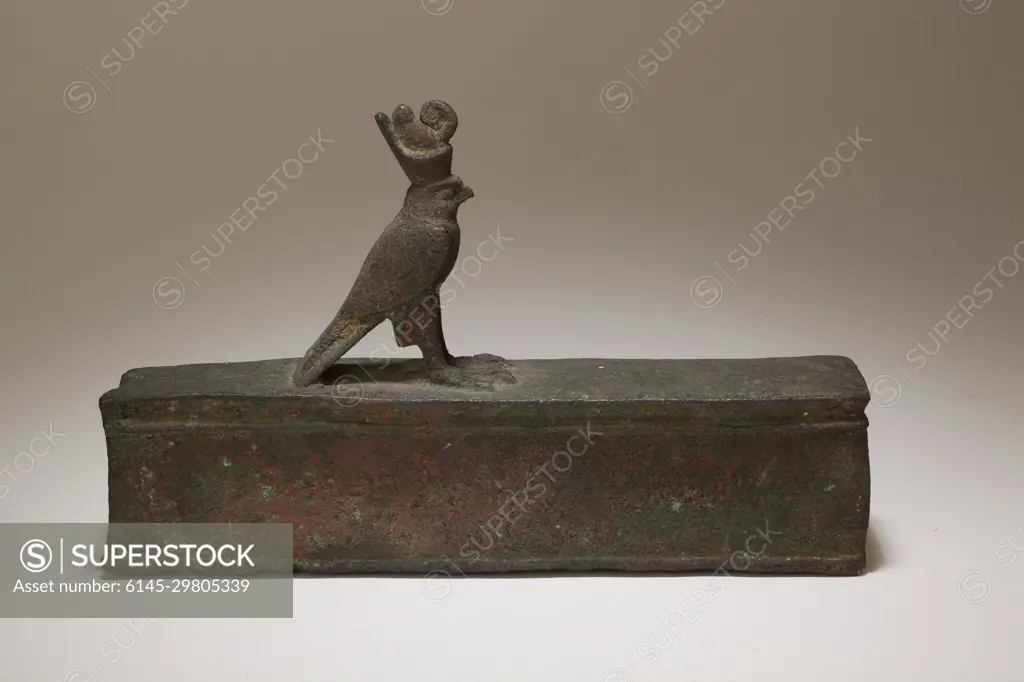
SuperStock offers millions of photos, videos, and stock assets to creatives around the world. This image of Case for an animal mummy topped by a falcon 664-30 B.C. Late Period-Ptolemaic Period The falcon god Horus stands with his wings swept back. He has a prominent beak, large rounded eyes, and a strong brow, which supports the double crown of Egypt. This royal crown symbolizes the union of Lower and Upper Egypt, and highlights Horus role as the legitimate ruler of the entire land. On this particular figure, the crowns elements are closely modeled together but are still distinct: the red crown of Lower Egypt, complete with its curling spiral at the front, and the white crown of Upper Egypt. The falcon wears the double crown because Horus and the concept of kingship were closely tied, as early as the Predynastic Period. The falcon stands on a rectangular receptacle that would have held an animal mummy. The back end is open where the mummy, now lost, would have been inserted. Such falcon mummy boxes, or sarcophagi, would have been offered for deposition in animal necropoleis, not just in re by Piemags/PL Photography Limited is available for licensing today.
Looking for a license?
Click here, and we'll help you find it! Questions? Just ask!
Click here, and we'll help you find it! Questions? Just ask!
DETAILS
Image Number: 6145-29805339Royalty FreeCredit Line:Piemags/PL Photography Limited/SuperStockCollection:PL Photography Limited Contributor:Piemags Model Release:NoProperty Release:NoResolution:4000×2667