Bodhidharma crossing the Yangzi River on a reed before 1317 Li Yaofu Chinese Bodhidharma was the legendary Indian patriarch who brought Chan Buddhism to China. After an unsuccessful audience with the Chinese emperor Liang Wudi (r. 502-49), Bodhidharma broke off a reed, crossed the Yangzi River, and proceeded to the Shaolin Temple [on Mount Song in Henan Province.”This painting is signed by Li Yaofu, whose name appears only in Japanese records, and is inscribed by Yishan Yining, the renowned Chinese missionary who went in 1299 to Japan. There, Yishan served as abbot of temples in Kamakura and Kyoto until his death. The inscription reads:Crossing rivers and deserts he came.Facing the emperor he confessed, I don’t know”;Unsuccessful, he moved on,His feet treading the water.While mainstream painters followed the style of Li Gonglin (ca. 1049-1106)—that of baimiao, or white drawing,” executed with a controlled line of uniform thickness—the Chan painter employed a more flexible brush sty
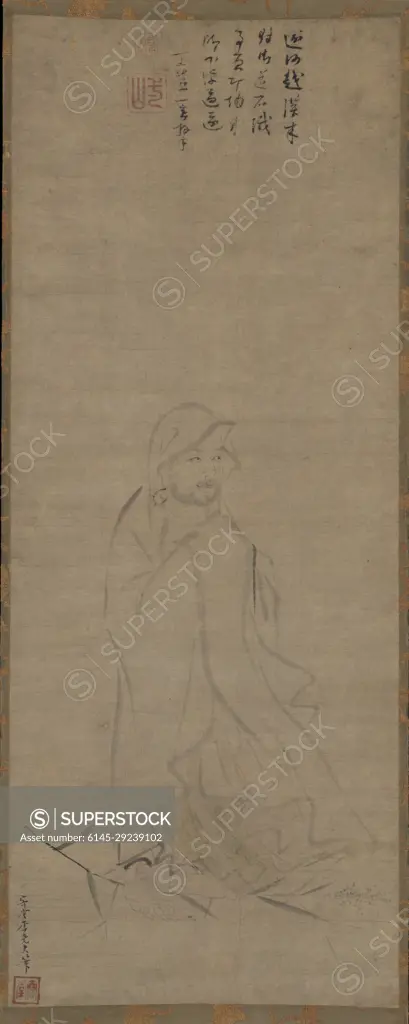
SuperStock offers millions of photos, videos, and stock assets to creatives around the world. This image of Bodhidharma crossing the Yangzi River on a reed before 1317 Li Yaofu Chinese Bodhidharma was the legendary Indian patriarch who brought Chan Buddhism to China. After an unsuccessful audience with the Chinese emperor Liang Wudi (r. 502-49), Bodhidharma broke off a reed, crossed the Yangzi River, and proceeded to the Shaolin Temple [on Mount Song in Henan Province.”This painting is signed by Li Yaofu, whose name appears only in Japanese records, and is inscribed by Yishan Yining, the renowned Chinese missionary who went in 1299 to Japan. There, Yishan served as abbot of temples in Kamakura and Kyoto until his death. The inscription reads:Crossing rivers and deserts he came.Facing the emperor he confessed, I don’t know”;Unsuccessful, he moved on,His feet treading the water.While mainstream painters followed the style of Li Gonglin (ca. 1049-1106)—that of baimiao, or white drawing,” executed with a controlled line of uniform thickness—the Chan painter employed a more flexible brush sty by Piemags/PL Photography Limited is available for licensing today.
Looking for a license?
Click here, and we'll help you find it! Questions? Just ask!
Click here, and we'll help you find it! Questions? Just ask!
DETAILS
Image Number: 6145-29239102Royalty FreeCredit Line:Piemags/PL Photography Limited/SuperStockCollection:PL Photography Limited Contributor:Piemags Model Release:NoProperty Release:NoResolution:1599×4000