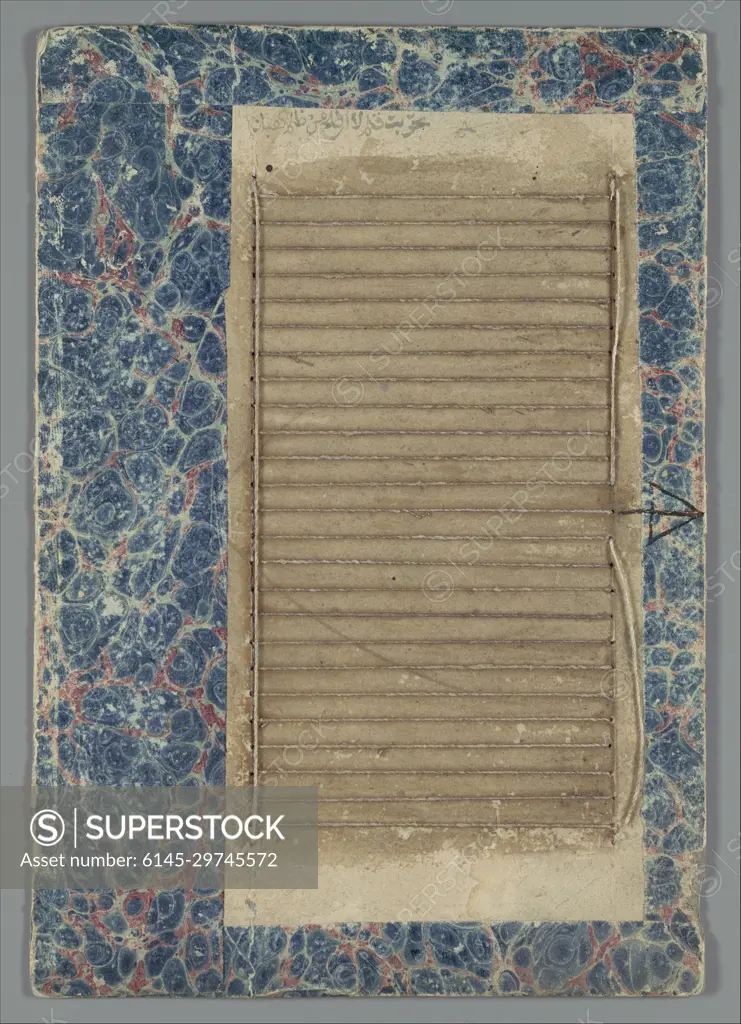
Board for Ruling Paper 17th-18th century Before the scribe could begin copying text onto folios, he had to rule the sheets in some discreet manner to produce lines to follow when writing the text. These lines could be made in a variety of ways. The most common method was to prick tiny holes with a needle or knife along the outer edges of the unfolded bifolios. The horizontal ruling lines were then made by connecting the prickings with a stylus that had a carbon or lead point. Ruling lines could also be produced in a faster manner, using an instrument called a ruling frame, a board with parallel strings or wires fixed across it. The slightly dampened paper would be pressed against the frame, and the strings would cause tiny raised ridges on each leaf, forming raised lines.. Board for Ruling Paper. 17th-18th century. Cotton twine and ink on paper. Attributed to Iran or Turkey. Codices
SuperStock offers millions of photos, videos, and stock assets to creatives around the world. This image of Board for Ruling Paper 17th-18th century Before the scribe could begin copying text onto folios, he had to rule the sheets in some discreet manner to produce lines to follow when writing the text. These lines could be made in a variety of ways. The most common method was to prick tiny holes with a needle or knife along the outer edges of the unfolded bifolios. The horizontal ruling lines were then made by connecting the prickings with a stylus that had a carbon or lead point. Ruling lines could also be produced in a faster manner, using an instrument called a ruling frame, a board with parallel strings or wires fixed across it. The slightly dampened paper would be pressed against the frame, and the strings would cause tiny raised ridges on each leaf, forming raised lines.. Board for Ruling Paper. 17th-18th century. Cotton twine and ink on paper. Attributed to Iran or Turkey. Codices by Piemags/PL Photography Limited is available for licensing today.
Looking for a license?
Click here, and we'll help you find it! Questions? Just ask!
Click here, and we'll help you find it! Questions? Just ask!
DETAILS
Image Number: 6145-29745572Royalty FreeCredit Line:Piemags/PL Photography Limited/SuperStockCollection:PL Photography Limited Contributor:Piemags Model Release:NoProperty Release:NoResolution:1383×1911