Beaker late 16th century Simon Kontz The engraved pattern of elongated leaf motifs on this beaker belong to the ornamental language of the Renaissance, while the openwork and robe bands are reminiscent of ornament from the late Gothic period. Two similar Hungarian beakers were excavated together with an Ottoman bowl and gold coins in 1910 at Makó. They are now in the Hungarian National Museum in Budapest.LiteratureJudit H. Kolba. Hungarian Silver: The Nicolas M. Salgo Collection. London, 1996, p. 29, no. 7.ReferencesElemér Kőszeghy. Magyarországi ötvösjegyek a középkortól 1867-ig / Merkzeichen der Goldschmiede Ungarns vom Mittelalter bis 1867. Budapest, 1936, similar to no. 1350 maker’s mark.Géza Fehér. Craftsmanship in Turkish-Ruled Hungary. Budapest, 1975, n.p., fig. 59.Wolfram Koeppe 2015. Beaker 236987
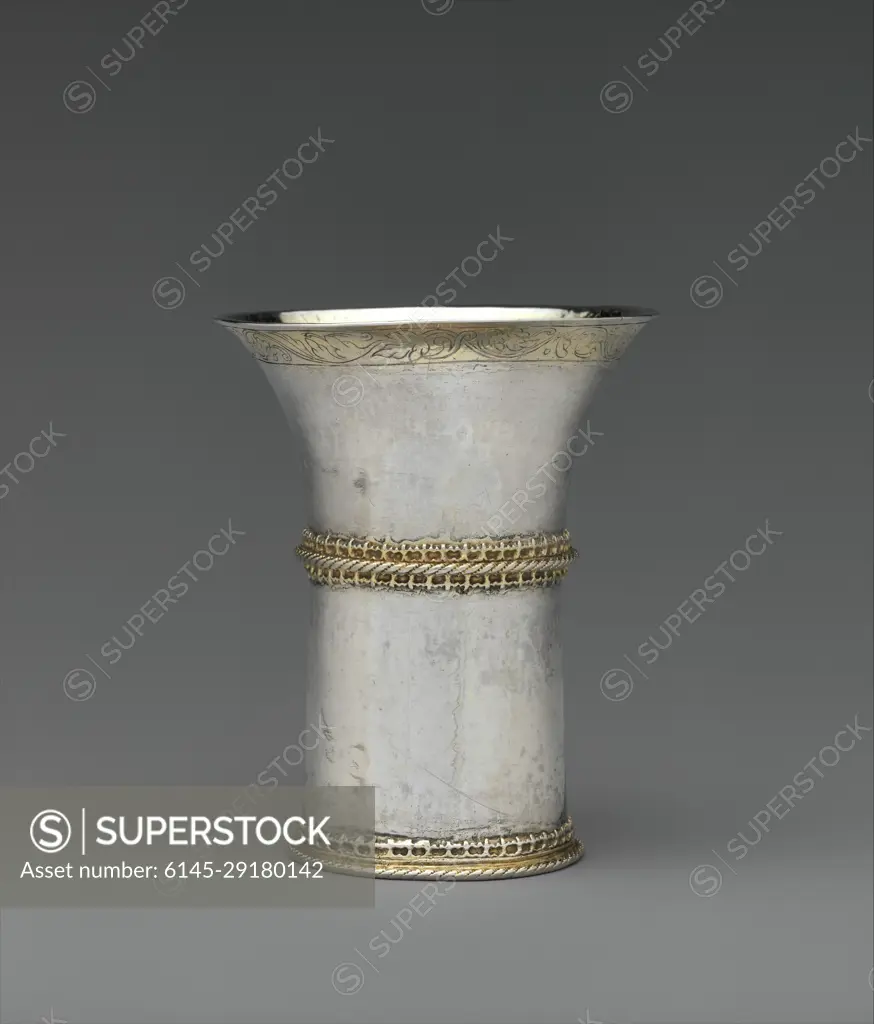
SuperStock offers millions of photos, videos, and stock assets to creatives around the world. This image of Beaker late 16th century Simon Kontz The engraved pattern of elongated leaf motifs on this beaker belong to the ornamental language of the Renaissance, while the openwork and robe bands are reminiscent of ornament from the late Gothic period. Two similar Hungarian beakers were excavated together with an Ottoman bowl and gold coins in 1910 at Makó. They are now in the Hungarian National Museum in Budapest.LiteratureJudit H. Kolba. Hungarian Silver: The Nicolas M. Salgo Collection. London, 1996, p. 29, no. 7.ReferencesElemér Kőszeghy. Magyarországi ötvösjegyek a középkortól 1867-ig / Merkzeichen der Goldschmiede Ungarns vom Mittelalter bis 1867. Budapest, 1936, similar to no. 1350 maker’s mark.Géza Fehér. Craftsmanship in Turkish-Ruled Hungary. Budapest, 1975, n.p., fig. 59.Wolfram Koeppe 2015. Beaker 236987 by Piemags/PL Photography Limited is available for licensing today.
Looking for a license?
Click here, and we'll help you find it! Questions? Just ask!
Click here, and we'll help you find it! Questions? Just ask!
DETAILS
Image Number: 6145-29180142Royalty FreeCredit Line:Piemags/PL Photography Limited/SuperStockCollection:PL Photography Limited Contributor:Piemags Model Release:NoProperty Release:NoResolution:3286×3847