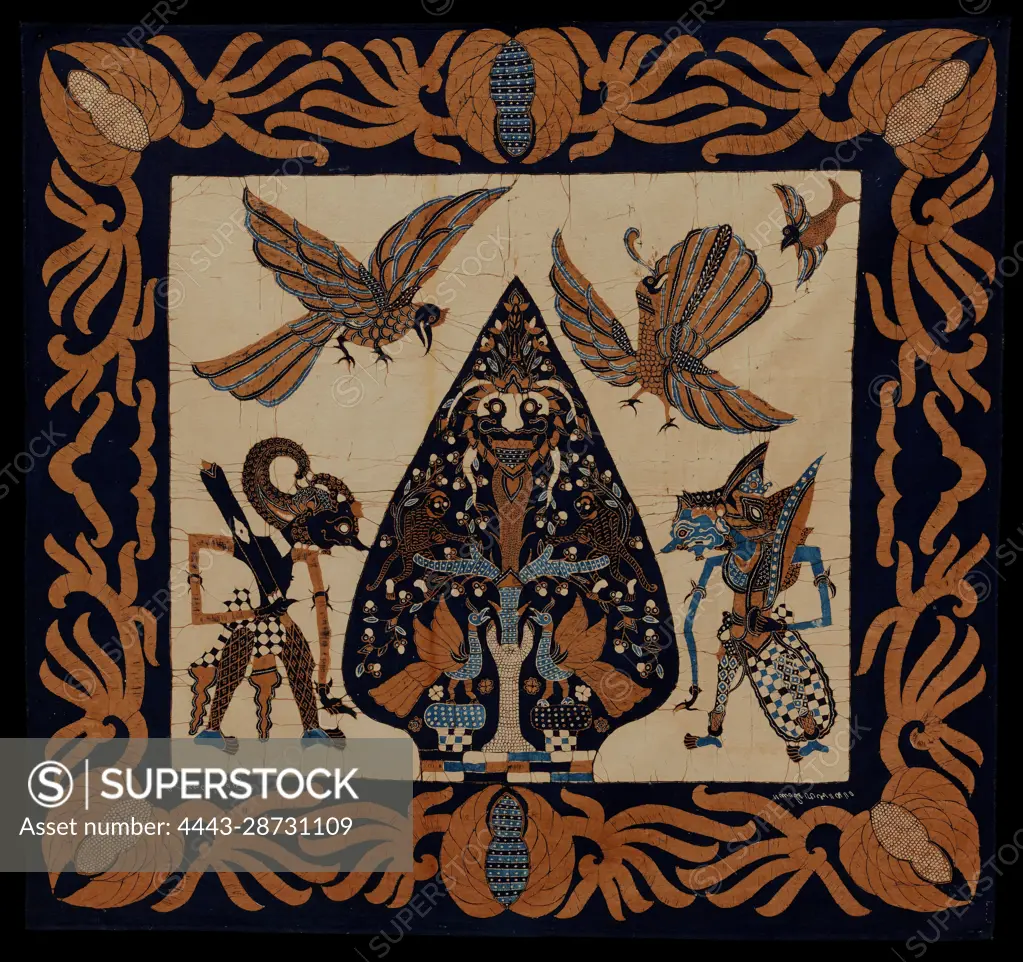
Batik panel, late 19th century-early 20th century, L.44-½ x W.42 in., cotton; dyed, Indonesia, 19th-20th century, The Indonesian island of Java is renowned for its production of batik textiles. Using a resist-dyeing process, batik makers, usually women, draw intricate patterns in wax (the resist) with a pen-like device over cotton cloth. Then they soak the fabric in successive batches of color dyes. Because the wax resists dyeing, once it is removed, the original design remains. The work is also known as tulis, or writing. Antecedents of batiks can be traced back to Indian textiles from the first millennium CE. Evolving on Java from 1600s court culture into a major industry under 1800s Dutch colonial rule, batiks feature a range of motifs, many of which are uniquely Javanese.
SuperStock offers millions of photos, videos, and stock assets to creatives around the world. This image of Batik panel, late 19th century-early 20th century, L.44-½ x W.42 in., cotton; dyed, Indonesia, 19th-20th century, The Indonesian island of Java is renowned for its production of batik textiles. Using a resist-dyeing process, batik makers, usually women, draw intricate patterns in wax (the resist) with a pen-like device over cotton cloth. Then they soak the fabric in successive batches of color dyes. Because the wax resists dyeing, once it is removed, the original design remains. The work is also known as tulis, or writing. Antecedents of batiks can be traced back to Indian textiles from the first millennium CE. Evolving on Java from 1600s court culture into a major industry under 1800s Dutch colonial rule, batiks feature a range of motifs, many of which are uniquely Javanese. by Artokoloro is available for licensing today.
Looking for a license?
Click here, and we'll help you find it! Questions? Just ask!
Click here, and we'll help you find it! Questions? Just ask!
DETAILS
Image Number: 4443-28731109Rights ManagedCredit Line:Artokoloro/SuperStockCollection:Artokoloro Model Release:NoProperty Release:NoResolution:5805×5459