Bass Viol 18th century Possibly by Matthias Humel German The viol and violin families both consist of bowed string instruments with hourglass silhouettes, but the two differ in the number of strings (four for the violin family, usually six for the viols), the tuning of the strings, and details of their shapes (thicker ribs and sloping shoulders for the viols, several shapes of soundholes for viols versus S-shaped soundholes for violins, flat backs for viols versus arched backs for violins, as well as far more variety of outlines for viols than violins). Viols have frets on their fingerboards, a feature that endeared the viol to amateur players then and now. All sizes of viols are played upright either between the legs or resting on them, and the bow is held underhand, so that the stronger bow stroke is the up bow, unlike the violin, whose more powerful motion is the down bow. Beginning in the late fifteenth century, viol consorts played all manner of notated western European polyphony,
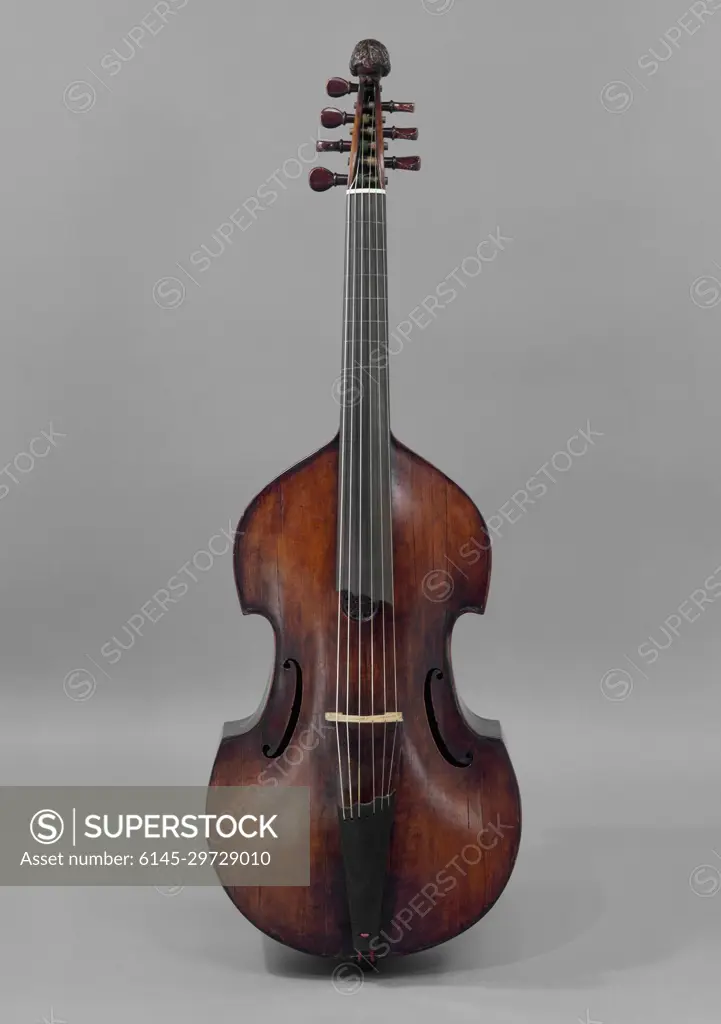
SuperStock offers millions of photos, videos, and stock assets to creatives around the world. This image of Bass Viol 18th century Possibly by Matthias Humel German The viol and violin families both consist of bowed string instruments with hourglass silhouettes, but the two differ in the number of strings (four for the violin family, usually six for the viols), the tuning of the strings, and details of their shapes (thicker ribs and sloping shoulders for the viols, several shapes of soundholes for viols versus S-shaped soundholes for violins, flat backs for viols versus arched backs for violins, as well as far more variety of outlines for viols than violins). Viols have frets on their fingerboards, a feature that endeared the viol to amateur players then and now. All sizes of viols are played upright either between the legs or resting on them, and the bow is held underhand, so that the stronger bow stroke is the up bow, unlike the violin, whose more powerful motion is the down bow. Beginning in the late fifteenth century, viol consorts played all manner of notated western European polyphony, by Piemags/PL Photography Limited is available for licensing today.
Looking for a license?
Click here, and we'll help you find it! Questions? Just ask!
Click here, and we'll help you find it! Questions? Just ask!
DETAILS
Image Number: 6145-29729010Royalty FreeCredit Line:Piemags/PL Photography Limited/SuperStockCollection:PL Photography Limited Contributor:Piemags Model Release:NoProperty Release:NoResolution:1294×1836