Bāburnāma (Chagatai/Persian: بابر نامہ;´, literally: 'Book of Babur' or 'Letters of Babur'; alternatively known as Tuzk-e Babri) is the name given to the memoirs of ahīr ud-Dīn Muḥammad Bābur (1483-1530), founder of the Mughal Empire and a great-great-great-grandson of Timur. It is an autobiographical work, originally written in the Chagatai language, known to Babur as 'Turki' (meaning Turkic), the spoken language of the Andijan-Timurids. Because of Babur's cultural origin, his prose is highly Persianized in its sentence structure, morphology, and vocabulary, and also contains many phrases and smaller poems in Persian. During Emperor Akbar's reign, the work was completely translated to Persian by a Mughal courtier, Abdul Rahīm, in AH 998 (1589-90 CE).
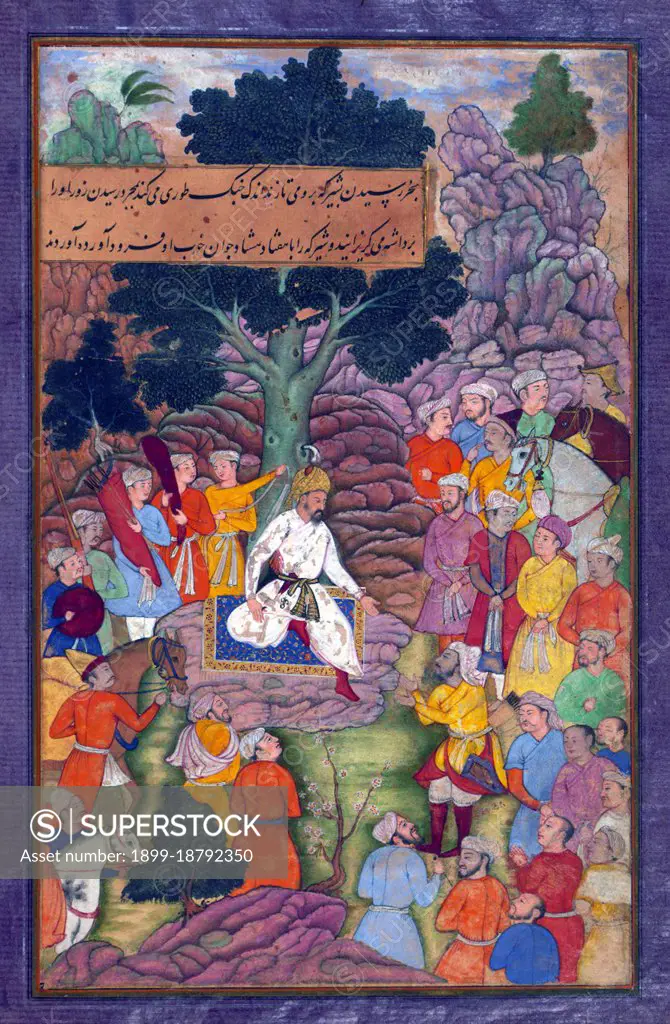
SuperStock offers millions of photos, videos, and stock assets to creatives around the world. This image of Bāburnāma (Chagatai/Persian: بابر نامہ;´, literally: 'Book of Babur' or 'Letters of Babur'; alternatively known as Tuzk-e Babri) is the name given to the memoirs of ahīr ud-Dīn Muḥammad Bābur (1483-1530), founder of the Mughal Empire and a great-great-great-grandson of Timur. It is an autobiographical work, originally written in the Chagatai language, known to Babur as 'Turki' (meaning Turkic), the spoken language of the Andijan-Timurids. Because of Babur's cultural origin, his prose is highly Persianized in its sentence structure, morphology, and vocabulary, and also contains many phrases and smaller poems in Persian. During Emperor Akbar's reign, the work was completely translated to Persian by a Mughal courtier, Abdul Rahīm, in AH 998 (1589-90 CE). by Pictures From History/Universal Images is available for licensing today.
Looking for a license?
Click here, and we'll help you find it! Questions? Just ask!
Click here, and we'll help you find it! Questions? Just ask!
DETAILS
Image Number: 1899-18792350Rights ManagedCredit Line:Pictures From History/Universal Images/SuperStockCollection:Universal Images Contributor:Pictures From History Model Release:NoProperty Release:NoResolution:3339×5100