Arhat (Luohan) 16th-17th century China This sculpture epitomizes the merging of religious and secular imagery in later Chinese Buddhist sculpture. With his shaven head and elongated earlobes, the figure resembles a luohan (one of the Indian disciples of the Buddha), but his refined facial features, dignified posture, long-sleeved robe, and pointed shoesall attributes associated with Confucian scholar-officialsidentify him unmistakably as a youthful monk.The sculpture’s tendency toward abstraction and stylizationthe contours of the head, body, and robes are conveyed through the buildup of simple, curved formsrecall thirteenth-century images, but a radiocarbon date suggests that the piece dates to between A.D. 1324 and 1617.. Arhat (Luohan). China. 16th-17th century. Wood (willow) with traces of pigment, single-woodblock construction. Ming dynasty (1368-1644). Sculpture
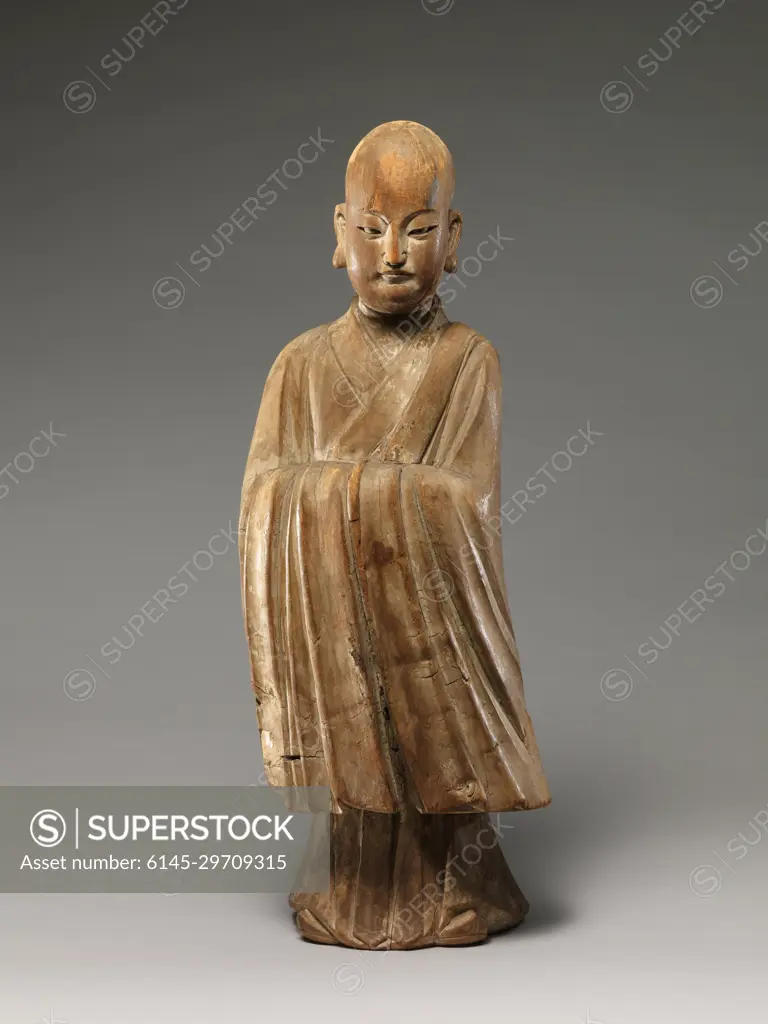
SuperStock offers millions of photos, videos, and stock assets to creatives around the world. This image of Arhat (Luohan) 16th-17th century China This sculpture epitomizes the merging of religious and secular imagery in later Chinese Buddhist sculpture. With his shaven head and elongated earlobes, the figure resembles a luohan (one of the Indian disciples of the Buddha), but his refined facial features, dignified posture, long-sleeved robe, and pointed shoesall attributes associated with Confucian scholar-officialsidentify him unmistakably as a youthful monk.The sculpture’s tendency toward abstraction and stylizationthe contours of the head, body, and robes are conveyed through the buildup of simple, curved formsrecall thirteenth-century images, but a radiocarbon date suggests that the piece dates to between A.D. 1324 and 1617.. Arhat (Luohan). China. 16th-17th century. Wood (willow) with traces of pigment, single-woodblock construction. Ming dynasty (1368-1644). Sculpture by Piemags/PL Photography Limited is available for licensing today.
Looking for a license?
Click here, and we'll help you find it! Questions? Just ask!
Click here, and we'll help you find it! Questions? Just ask!
DETAILS
Image Number: 6145-29709315Royalty FreeCredit Line:Piemags/PL Photography Limited/SuperStockCollection:PL Photography Limited Contributor:Piemags Model Release:NoProperty Release:NoResolution:3001×4000