Archlute ca. 1725 David Tecchler Austrian, active Italy Sometime after the invention of the chitarrone ("large kithara") in Florence around 1585, various local forms of long-necked lutes were developed. One variant appearing in Rome at the end of the sixteenth century, dubbed the Roman arch lute, accommodated unfretted diatonic bass strings and was tuned to a pitch standard of about 386 hertz (a full step below the modern pitch standard), and was used in many churches. Only ten such instruments are known today, of which this example is the latest and one of the most beautiful. By the end of the through bass period, in the middle of the eighteenth century, the arch lute had become an indispensable instrument of the orchestra.This example was built by the most prominent Roman luthier of the early eighteenth century, David Tecchler, who was born in Germany and moved from Augsburg to Rome in 1698 where he lived until his death. Renowned for his violins, and especially, his cellos, Tecchle
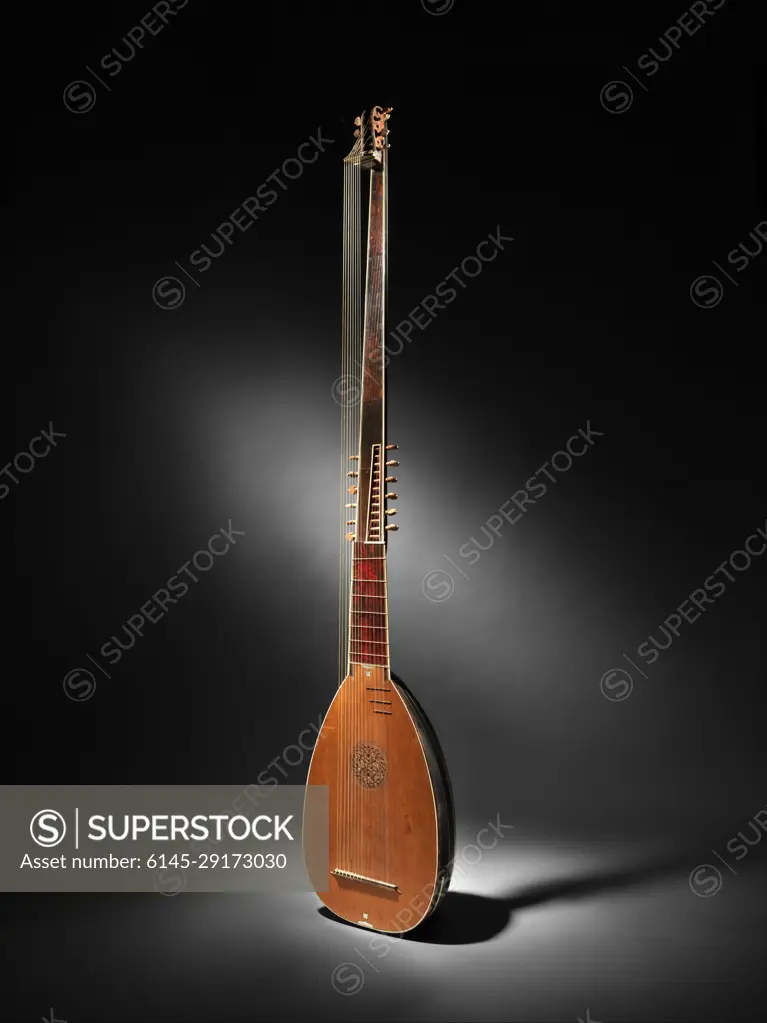
SuperStock offers millions of photos, videos, and stock assets to creatives around the world. This image of Archlute ca. 1725 David Tecchler Austrian, active Italy Sometime after the invention of the chitarrone ("large kithara") in Florence around 1585, various local forms of long-necked lutes were developed. One variant appearing in Rome at the end of the sixteenth century, dubbed the Roman arch lute, accommodated unfretted diatonic bass strings and was tuned to a pitch standard of about 386 hertz (a full step below the modern pitch standard), and was used in many churches. Only ten such instruments are known today, of which this example is the latest and one of the most beautiful. By the end of the through bass period, in the middle of the eighteenth century, the arch lute had become an indispensable instrument of the orchestra.This example was built by the most prominent Roman luthier of the early eighteenth century, David Tecchler, who was born in Germany and moved from Augsburg to Rome in 1698 where he lived until his death. Renowned for his violins, and especially, his cellos, Tecchle by Piemags/PL Photography Limited is available for licensing today.
Looking for a license?
Click here, and we'll help you find it! Questions? Just ask!
Click here, and we'll help you find it! Questions? Just ask!
DETAILS
Image Number: 6145-29173030Royalty FreeCredit Line:Piemags/PL Photography Limited/SuperStockCollection:PL Photography Limited Contributor:Piemags Model Release:NoProperty Release:NoResolution:2920×3894